St Patrick’s Festival Dublin 2027 on a budget
Dublin · 13–17 March 2027 · independent travel guide
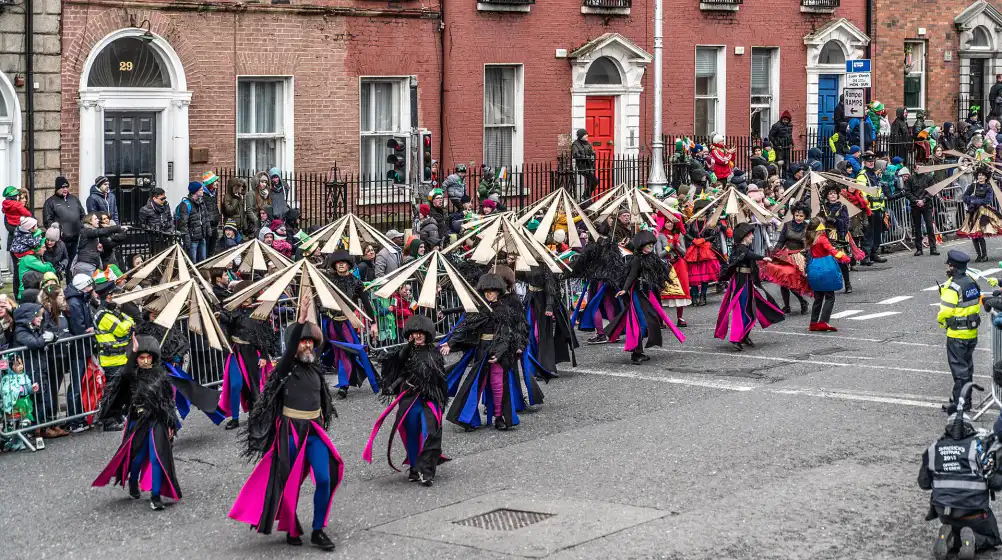
Marching bands echoing between Georgian buildings, gigantic street-theatre creations moving down O’Connell Street and families wrapped in green against the wind: St Patrick’s Day in Dublin is far bigger than a night in the pub. It is a celebration you can experience largely for free. The expensive part is often finding somewhere sensible to sleep—and booking the right nights in the first place.
What is St Patrick's Festival in Dublin?
17 March is Ireland's national day, named after its patron saint, St Patrick. Today's celebration draws on Irish history and identity, but the Dublin festival also fills the city with music, dance, street theatre and performances by people from Ireland and beyond. The main parade is not a military march or a pub crawl. Expect elaborate floats, community groups, marching bands and plenty of families, alongside visitors who have travelled to experience the atmosphere.Green clothes and flags are part of the picture, but Dublin's festival is not just about wearing something green and finding a busy bar. An outdoor performance, a marching band you hear approaching before you see it, and whole streets turning into a celebration tell a richer story. You can watch the parade without a ticket. You cannot assume that accommodation will be inexpensive. That distinction shapes the entire trip.
Quick answer: the dates, nights and best areas
St Patrick's Festival 2027 runs from Saturday 13 to Wednesday 17 March. The national parade starts at noon on Wednesday 17 March. If the parade is your reason for coming, 16–18 March is the focused two-night stay; 15–18 March allows three nights and some proper time to explore Dublin. A weekend trip from 13 to 15 March catches early festival activities but misses the main parade.
To avoid paying a premium just for nightlife, start your accommodation search around Parnell Street, Connolly and Smithfield rather than assuming that Temple Bar is where you need to sleep. Compare Dublin rooms for 16–18 March 2027 and then check the actual walking route to your chosen parade viewpoint. “Central” on a listing is not the same as accessible during road closures.
Jump to
- 2027 festival dates
- Which nights?
- Watch the parade
- Where to stay
- Realistic budget
- Transport
- Trip plans
- Mistakes to avoid
- FAQs
St Patrick's Festival 2027: confirmed dates and parade route
The key date is Wednesday 17 March 2027, at midday. The National St Patrick's Day Parade begins at the northern end of the city centre around Parnell Square / Granby Row, heads down O'Connell Street, crosses O'Connell Bridge and continues south, finishing near the Cuffe Street / Kevin Street junction. The published route is roughly 3.2 km long. Standing spectators do not need a ticket. Grandstands provide optional paid, allocated seats. Check the official route map before picking your viewing area.| Date | What it means for visitors |
|---|---|
| Saturday 13 March | First day of the five-day festival: a chance to enjoy the city and opening activities. |
| Sunday 14–Tuesday 16 March | Festival performances and cultural activities, subject to the final daily programme. |
| Wednesday 17 March | The noon parade: the major gathering and significant city-centre transport disruptions. |
| Thursday 18 March | Sensible departure day for visitors who travelled specifically for the parade. |
The organisers say that the full 2027 programme will be published in January 2027. There are usually concerts, street performances, family-oriented activities and traditional music or dance, but do not treat a time from a previous year as a confirmed 2027 event. Most festival activities are free, though some require advance registration or a paid ticket. The official festival visitor information is the best place to check once the detailed schedule arrives.
Book the right nights, not just the cheapest flight
There are really two useful accommodation searches for travellers who want the main parade. They include the Wednesday celebration and avoid the trap of flying home before it starts. Prices can be higher precisely because these dates coincide with the biggest event; shorter does not automatically mean better value, but it reduces the number of nights you pay for.16–18 March: two nights, parade first
Best for: travellers with limited leave who want to see the Wednesday procession rather than every festival event. Arrive Tuesday, stay through Wednesday night and fly home Thursday. This is a clear, efficient plan.
Trade-off: you have little time for museums, the coast or a leisurely cultural itinerary. A late arrival on Tuesday turns the trip into almost a single full day.
15–18 March: three nights, a better city break
Best for: travellers who also want to see Dublin beyond the green crowds. Monday or Tuesday can be spent exploring museums, neighbourhoods and cafés, while Wednesday remains completely free for the festival.
Trade-off: that extra night has a real cost. Compare accommodation for 15–18 March against the two-night option with the same number of guests, not against a random midwinter advertised rate.
What about 13–15 March? That weekend belongs to the festival, and some visitors may prefer its earlier activities and atmosphere. It is also a reasonable choice for someone who dislikes a huge parade crowd. But anyone booking those flights specifically for the national procession will be disappointed: the parade is on Wednesday 17 March, not the preceding weekend.

How to watch Dublin's parade for free
The route is long, but trying to see the same parade from several vantage points is rarely worth it. On 17 March, the crowds and barriers make even short journeys harder. Pick one stretch of the route, reach it early and stay put. The festival itself recommends arriving in good time. Exactly when you need to arrive depends on how close to the front you want to be; no publication can guarantee a perfect position at a fixed time.O'Connell Street is the classic high-energy choice, with impressive street views and the density that goes with them. It can be wonderful for adults happy to stand for several hours, but less comfortable for small children, anyone needing a seat or travellers with sensory sensitivities. A quieter-looking side of the route may be a better fit, although crowds and access barriers can change on the day. Check the official map rather than trusting an unverified claim about a “secret” viewing location.
Grandstand seating is an entirely different product. It may be worth paying for if you need a designated seat or more predictable visibility. The covered, tiered grandstands are sold through the official festival ticket page. Their rates depend on the area, so check the current 2027 prices rather than relying on a previous year's figure. For many budget travellers who can comfortably stand, the free parade is the better choice.
Bring a waterproof outer layer, warm clothing, comfortable footwear and something to drink. The procession takes time to pass, and leaving your place for refreshments can mean losing your position. There are official plans for wheelchair-accessible viewing and a relaxed parade space for people with additional sensory needs, with applications scheduled to open in January 2027. Those arrangements deserve a proper look if they apply to you; a generic suggestion to “avoid the crowds” is not enough.

Where to stay for St Patrick's Day in Dublin
A hotel address should make the day easier, not just look attractive on a map. The city centre is walkable, but road closures can turn a short cross-town bus ride into an awkward detour. Similarly, Temple Bar is a fine place to visit and a questionable place to pay a premium for sleep if noise matters to you.Parnell Street: close to the northern parade route
For visitors travelling primarily for the procession, the streets around Parnell are straightforward. You can reach the northern end of the route on foot and avoid crossing the city to get there. Point A Hotel Dublin Parnell Street, on Moore Lane, suits travellers who would rather have a functional room in a strong location than extra space they will barely use. It is not guaranteed to be cheap during the festival: compare the total, window and noise options, and cancellation terms.
This is a location-led recommendation, not a promise of peace and quiet. The parade draws people toward the area, and the surrounding streets can be busy.
Smithfield and Stoneybatter: breathing room and neighbourhood pubs
Smithfield gives you access to central Dublin without forcing every evening into Temple Bar. Maldron Hotel Smithfield Dublin City is worth comparing if you want a conventional hotel near cafés and restaurants, with a Luas stop for other days. The important caveat is 17 March itself: tram restrictions may affect services across the city centre. Book Smithfield because you are happy with the walking route, not because you assume the tram will deliver you through every parade closure.
Stoneybatter is especially appealing if your idea of a good evening is a neighbourhood pub rather than a packed tourist strip. A cheaper hotel further out is not automatically better value if it makes every meal and return journey less pleasant.
Connolly and Talbot Place: solo travellers and hostels
If you are travelling alone or with friends, Latroupe Jacobs Inn, on Talbot Place near Connolly Station, is a practical hostel option with dorm beds and private rooms. Compare the per-person total, room sharing arrangement and cancellation policy. An event-week dorm bed can be expensive; two people sharing a compact private room sometimes do better.
Connolly is useful for train and DART connections on days when the city is not closed around the parade. On the 17th, however, nearby streets may be busy. Check how you will get back on foot rather than assuming a bus can stop outside.
Pearse, Trinity and Mark Street: combine the festival with sightseeing
For a more rounded city break, Staycity Aparthotels Dublin Mark Street offers a different benefit: kitchenettes in a central location close to Trinity and Pearse. Being able to prepare breakfast and an occasional simple meal may matter more to your two- or three-night budget than a headline room rate. It also reduces dependence on busy cafés around the parade.
This is a good base for exploring the city, not necessarily the closest starting point for every parade viewpoint. Choose your position first and check which crossings remain convenient.
Should you stay in Temple Bar? Go there for the energy if that is what you enjoy, but look twice before paying festival prices for a room on a lively street. Dublin's nightlife is not confined to one block, and a good night's sleep is unusually valuable when you intend to stand outside for hours.

What does a two-night Dublin St Patrick's trip cost?
For many visitors, the hotel is the single most important cost. These are two transparent *planning examples* for two adults sharing one room from 16 to 18 March 2027, excluding flights or other travel to Ireland. They are not live hotel quotes, and neither nightly figure should be advertised as available for these dates.| Total for 2 people | Tight but workable example | More comfortable example |
|---|---|---|
| Double room, two nights | €350 (€175/night) | €540 (€270/night) |
| Food and coffee | €140 | €180 |
| Airport and local transport | €40 | €50 |
| Sightseeing / contingency | €30 | €60 |
| Trip total for two | €560 | €830 |
| Per person | €280 | €415 |
The arithmetic matters. If the room you actually find costs €300 per night instead of €175, your couple's total rises by €250 over two nights even though the parade still costs nothing. Prices may be significantly higher close to the festival. Moving to a quieter area or choosing fewer nights can make a bigger difference than skipping a €20 attraction.
Solo travellers need their own calculation: a room cannot be divided between two people. Start with dorm beds and private hostel rooms, then compare small hotels. Families should check actual room occupancy and bedding, not assume a two-adult quote fits everyone.
Before committing, compare actual arrival and departure times on our flight search as well: a low airfare with a late arrival can cost you the better part of your only free evening.
The two costs I would protect are a reasonable cancellation policy and an easy walking route on 17 March. The two I would drop first are an expensive Temple Bar address and a grandstand ticket you do not need. Likewise, paid breakfasts and an overstuffed list of attractions can add up faster than expected.
From Dublin Airport to the parade: transport without a car
Dublin Airport has public buses and dedicated airport coaches. Official airport listings include Dublin Express 782/784, Aircoach services and Dublin Bus routes such as 16 and 41. Check the hotel's precise location, service timetable and where that vehicle actually stops before booking a late flight. This can be more important than the small headline difference in ticket prices. The Dublin Airport bus directory is a useful starting point.A Leap Visitor Card can be convenient if you will use local Dublin buses, the Luas tram and DART. As a 2026 reference only, Transport for Ireland advertised €16 for 72 hours and €8 for 24 hours. Recheck the prices for March 2027; the card does not cover every dedicated airport express. If you are staying centrally and mostly walking, compare pay-as-you-go fares before automatically buying a multi-day pass. The latest transport information is on Transport for Ireland.
On Wednesday 17 March, assume central transport will be disrupted. There have been bus diversions, temporary route changes and Luas restrictions during previous parades, but the precise 2027 closure schedule is still to be announced. Do not plan a tight airport transfer crossing the parade at midday. If you can reach your chosen viewpoint on foot, that is the lower-stress option.

Two short itineraries that actually work
### Two nights: Tuesday 16 to Thursday 18 MarchTuesday 16: try to arrive during the afternoon. Check into your room, walk beside the Liffey and visit the areas around Trinity or the quays. Eat somewhere you like rather than defaulting to the loudest venue in Temple Bar. Most importantly, walk the route from your hotel to your preferred parade section so you are not improvising with thousands of other visitors in the morning.
Wednesday 17: eat breakfast early and bring a waterproof layer, water and comfortable shoes. Claim your spot in advance, enjoy the procession and resist the temptation to chase it across the centre. Afterwards, allow the streets to clear and find somewhere to eat without joining another enormous queue. A reserved dinner or neighbourhood meal can be the nicest part of the day.
Thursday 18: leave a sensible buffer for the airport. Depending on your departure time, finish with coffee or a slow walk; avoid paying for an attraction you would have to rush through.
Three nights: Monday 15 to Thursday 18 March
Use Monday 15 for the side of Dublin that is less obvious in parade photographs: the Trinity area, Merrion Square, galleries and quieter streets. Our two-day Dublin itinerary offers a useful framework for libraries, neighbourhoods and a well-paced visit beyond the festival. On Tuesday 16, choose one meaningful paid attraction if you want one. The Guinness Storehouse offered standard tickets from €24 in 2026, with dynamic prices and timed entry; it is an optional outing, not a requirement for a successful St Patrick's visit. Free museums and a neighbourhood walk may suit a tight budget better.
Keep Wednesday 17 almost entirely clear for the parade, and depart Thursday as above. This way you get a city break as well as the festival, rather than spending every waking minute managing crowds.

Eight mistakes that make the trip cost more
- Booking 13–15 March and expecting the big parade. It happens on Wednesday 17 March. - Treating an off-season hotel's “from” rate as a March 2027 price. Compare real dates, taxes and cancellation conditions. - Assuming Temple Bar is the only neighbourhood with atmosphere. It can mean noise and unnecessary expense. - Paying for a grandstand because you think the parade requires a ticket. Standing spectators can watch for free. - Depending on a cross-centre bus at noon on the 17th. Routes and stops may change around closures. - Comparing hostel and hotel prices without adjusting for the number of guests. Price a solo bed and a shared double room correctly. - Adding every brewery, distillery, guided tour and ticketed night out. Pick the one that actually matters to you. - Flying home halfway through the 17th. Unless you deliberately intend to miss the parade, leave on the 18th.Frequently asked questions
### Is the St Patrick's Day parade in Dublin free in 2027?Yes. The 17 March 2027 noon parade can be watched for free along its standing areas. Paid grandstands and some separate festival events are optional.
Is St Patrick's Day in Dublin on a weekend in 2027?
No. 17 March 2027 falls on a Wednesday. The festival starts on Saturday 13 March, but the main parade is on Wednesday. This is the main date mistake to avoid.
How many nights should I stay?
16–18 March is a sensible two-night trip if the parade is your priority. 15–18 March allows more time to explore the city. A 13–15 March weekend captures some festival atmosphere but misses the parade.
Where should budget travellers stay?
Consider Parnell Street for its location near the northern parade route, Smithfield for a more balanced base, Connolly for hostel options, and Mark Street/Pearse for a culture-led trip with possible self-catering. None is guaranteed cheap; compare total prices for your exact nights.
Can I get around Dublin without a car?
Yes. A car is more trouble than help in the city centre during the festival. Walk when possible, and use Dublin Bus, Luas or DART on other days. Check parade-day diversions.
Is the parade family-friendly?
The festival welcomes families, but the long wait, loud bands and dense crowds may be tiring for children. Bring snacks, rain protection and an exit plan; consult the official festival accessibility and relaxed-space arrangements if appropriate.
What should I wear in Dublin in March?
Plan for changeable, chilly and possibly wet weather. Layers, a waterproof jacket and supportive footwear are more important than elaborate green accessories if you will stand outside for a couple of hours.
A good St Patrick's Day visit is not measured by how many pubs or paid attractions you can squeeze in. It is one that gets you to the parade comfortably, gives you a decent night's sleep, and leaves enough room to enjoy the city behind the green crowds.