Cheap Northern Lights in Europe: 5 Budget-Friendly Destinations
Oulu, Luleå, Rovaniemi, Kiruna-Abisko or Tromsø: compare budget, aurora chances, car-free access and tours to choose where to go.
Northern Lights · Europe · budget travel
Seeing the Northern Lights can be free. Getting yourself far enough north to see them usually is not.
A €90 room is not automatically a better deal than a €140 room if the first one forces you to pay for transport or a tour every evening. A slightly more expensive destination can work out better if you can walk outside after dinner, watch the sky and make several attempts without adding a new cost each night.
That is why this comparison looks at the cost of the whole stay, not just the hotel: Oulu, Luleå, Rovaniemi, Kiruna/Abisko and Tromsø. If you would rather build the trip around a Nordic capital than an Arctic base, our Helsinki in winter without a car guide takes a very different approach with saunas, Suomenlinna and urban transport.
No destination can honestly guarantee an aurora on a specific date. You need darkness, enough solar activity and, above all, a sufficiently clear sky. On a short trip, cloud cover can matter more than a dramatic KP forecast on an app.
Where can you see the Northern Lights without blowing the budget?
The best choice depends less on the fame of the destination than on how many nights you can realistically try without paying for a new activity every evening.
Oulu
A real city with nearby viewing spots
Nallikari and Hollihaka give you genuine chances to try independently rather than turning every evening into a paid tour.
Luleå
Good independence close to town
Places such as Ormberget make it possible to step away from city lights without travelling deep into Lapland.
Rovaniemi
The easiest Lapland trip to organise
Flights, trains, hotels and activities are easy to combine. The real challenge is not adding too many paid experiences.
Kiruna / Abisko
More expensive, often better weather odds
Abisko is famous for keeping patches of clear sky even when nearby areas remain cloudy.
Tromsø
The easiest logistics
You can organise everything from the city and use a mobile chase only when the weather really makes it worthwhile. For a full itinerary, our Tromsø in winter without a car guide covers four days, where to stay and a realistic budget.
Our strategy: three nights is the minimum; four is better. An extra night often gives you more value than a second tour booked before you have even seen the forecast.
Do the Northern Lights really look like the photos?
Not always — and this is worth knowing before you travel.
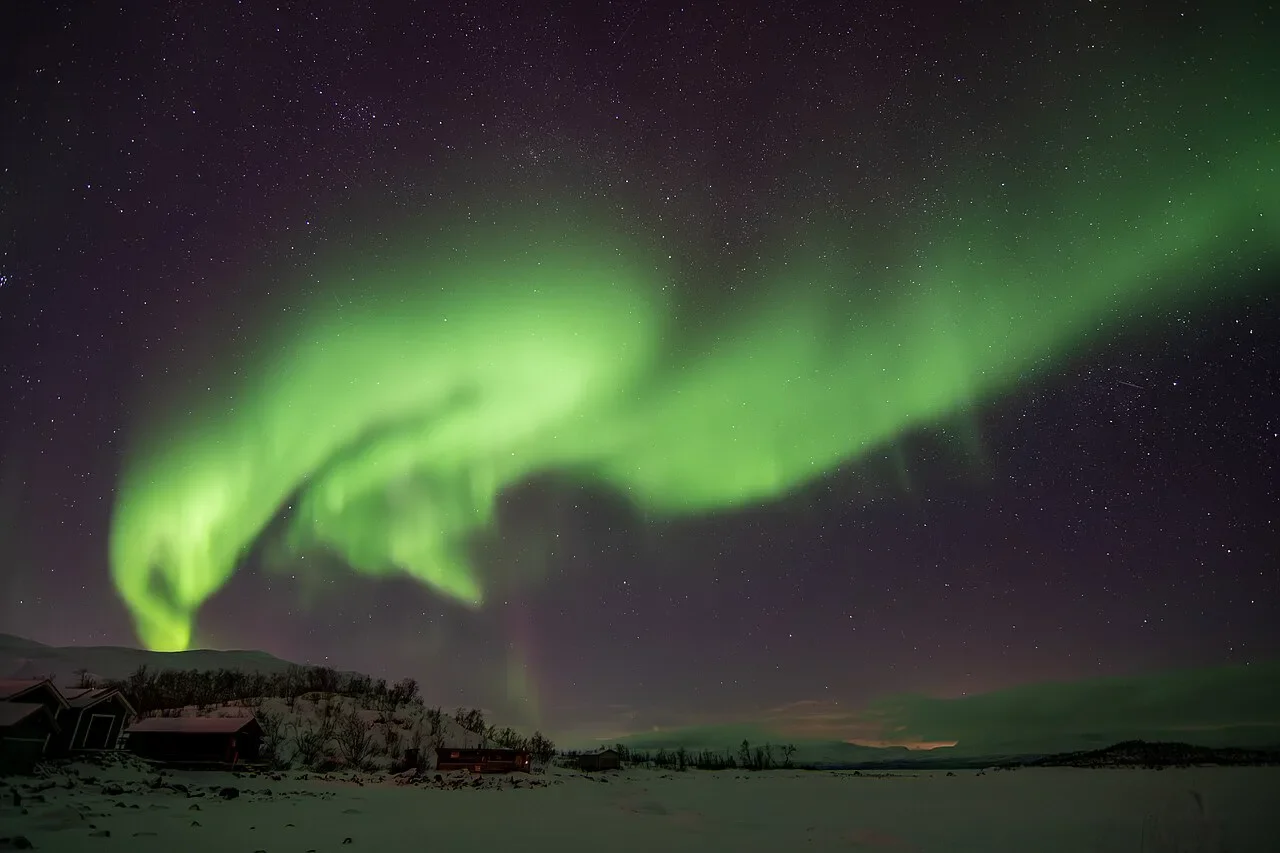
A strong aurora can be spectacular to the naked eye: clearly visible green, large curtains of light, fast movement and sometimes red or violet tones.
When it is weak, however, it may first look like a pale grey or whitish veil with a slight green tint, especially before your eyes have fully adapted to the dark.
A camera or a smartphone in night mode collects more light than the human eye. The image can therefore show a much stronger green, more colour and more detail than you could see in real time.
That does not make the photo “fake”: your eye and the sensor simply record the night differently.
If your phone suddenly shows a bright green band while you mainly see a faint pale haze, look carefully at the sky: you may already be watching a weak aurora.
Try not to spend the entire evening staring at a screen either. A few minutes without phone light helps your night vision settle and makes subtle movement easier to pick out.
How much should you budget for three nights?
The ranges below are rough per-person planning figures for two travellers sharing a room, excluding the main journey to the destination. They include accommodation, simple meals, local transport and a few daytime sights or activities.
| Destination | Controlled ground budget | With one proper guided chase | Can you try for free? |
|---|---|---|---|
| Oulu | €260–420 | €360–540 | Yes |
| Luleå | €280–460 | €380–580 | Yes |
| Rovaniemi | €310–500 | €420–650 | Yes |
| Kiruna / Abisko | €380–600 | €500–750 | Yes |
| Tromsø | €430–650 | €550–850 | Yes, but mobility helps |
Christmas, February, school holidays and some weekends can move these ranges sharply. The important point is simpler: one guided evening can cost almost as much as an extra hotel night.
For a sensible budget, we would rather stay three or four nights and add one guided chase only if it becomes useful than squeeze the trip into two nights already filled with prepaid tours before seeing the weather.
Oulu: the destination that deserves far more attention
Oulu rarely appears at the top of international Northern Lights rankings. That is exactly what makes it interesting.
The city sits on the Gulf of Bothnia in northern Finland, while still functioning as a normal urban destination with hotels, restaurants and public transport. You avoid some of the premium that comes with places built almost entirely around Arctic tourism.
Visit Oulu estimates that the lights are visible in the region around one winter night in four. Nallikari Beach is roughly 3.5 km from the centre, while Hollihaka Park is only around one kilometre away.

First step: look at the sky before booking anything
If the stars are visible and the forecast looks decent, Nallikari already gives you a wide horizon over the sea. Bus 15 generally connects the centre with the beach into the evening, often until around 10 pm, but check the timetable for your dates: a late taxi can quickly erase the saving made on the hotel.
With three or four nights, there is no need to fill the first evening in advance.
What if the clouds stay over Oulu?
That is when a mobile chase becomes more useful. Instead of waiting in the same place, a guide can look for a clearer area elsewhere in the region and adapt the viewing location to the conditions that night.
See Northern Lights outings around Oulu.
City centre or towards Nallikari
The centre is easier for restaurants and transport. Nallikari becomes appealing if you want to be able to step back outside at night without organising a full expedition.
Oulu is also the European Capital of Culture 2026, which is a real advantage on a grey day or a cloudy evening when the sky offers no realistic chance.
Verdict: our first choice if you want several independent attempts without turning every evening into another major expense.
Luleå: an Arctic city where you can still improvise
Luleå follows a similar logic to Oulu. It is not a resort built only around aurora tourism: it is a northern Swedish city on an archipelago that changes completely in winter.
Visit Luleå describes a Northern Lights season running from late August into the first days of April, when the sky is dark and clear enough.

Ormberget: the straightforward option from town
Ormberget is one of the classic places suggested locally. It is only a short ride from the centre, including on bus line 2, and gives enough distance from the urban lights for a sensible first attempt.
Other areas such as Gäddvik or Sinksundet can offer more darkness, but become less convenient without a vehicle.
Why several nights matter here
Luleå works well if you keep the evenings flexible. If it is cloudy, you have lost nothing to a booking. If it clears, you can decide to head out.
During the day, snow, winter trails and the frozen coastal landscape also make it possible to build a real three-day trip rather than simply waiting for darkness.
Central Luleå
For three or four nights without a car, staying central keeps restaurants and transport to Ormberget easy.
Verdict: a very good balance for travellers who want Arctic Sweden with several chances to go out independently.
Rovaniemi: very easy to organise, also very easy to overspend
Airport, railway station, hotels, restaurants, Santa Claus Village and dozens of activities: Rovaniemi is probably the simplest destination in this shortlist to organise.
The Northern Lights can be seen around Rovaniemi from late August to early April. The local tourism office also points out that you do not have to travel very far from the centre to find darker surroundings.

If the aurora is the priority, Christmas would not be our first choice
December brings polar darkness and a very strong atmosphere, but also the city’s most symbolic period. If Santa is not central to the trip, that premium is difficult to justify automatically.
March is much more appealing. Snow is still very much part of the landscape, daylight returns quickly and the aurora season continues. Visit Rovaniemi gives roughly 12 hours of daylight in March compared with around 2.5 hours on average in December.
When a guided chase becomes useful
Rovaniemi has a huge number of evening departures. If the sky is the main purpose of the trip, look for a genuinely mobile chase that can change direction with the cloud cover rather than an activity where the aurora is only a hoped-for backdrop to a fixed programme.
See Northern Lights chases in Rovaniemi.
City centre rather than an isolated glass igloo
A central hotel keeps restaurants, buses and tour departures easy. Panoramic cabins are beautiful, but they cannot guarantee that the sky above them will be clear that night.
Verdict: the easiest gateway to Finnish Lapland, especially appealing in February or March.
Kiruna and Abisko: paying a little more for a sky that often cooperates
Abisko is not our cheapest destination. It is, however, one of the places where paying extra makes the most sense.
Visit Sweden describes Abisko National Park as one of the country’s most reliable Northern Lights locations. Its position between the mountains often allows it to keep clear patches of sky while nearby areas remain cloudy.

Kiruna or Abisko?
Kiruna wins on shops, restaurants and accommodation choice.
Abisko wins on darkness, surroundings and simplicity once you are there: when a clear window appears, you can often just step outside.
Abisko is around 100 km from Kiruna. On a short trip, we would therefore avoid building the itinerary around a nightly return journey between the two.
3–4 nights in Abisko
You pay more for the location, then can make repeated attempts on foot whenever the sky opens.
3–4 nights in Kiruna
More services in town, with the option of one trip towards Abisko during the stay.
Kiruna or Abisko depending on your priority
The room rate is only part of the calculation: also look at transfers and how many evenings you will be able to simply step outside.
Verdict: not the cheapest, but one of the best places to justify spending more when the Northern Lights are genuinely the main reason for the trip.
Tromsø: the easiest logistics, with a higher overall cost
Tromsø is almost the opposite of Oulu: everything is extremely easy to organise, and that convenience costs more.
The Northern Lights season generally runs from late August to early April. When the activity is strong enough and the sky is clear, the lights can even appear above the city; Prestvannet is one of the darker local spots commonly recommended.

Why mobility matters more here
The coast around Tromsø has changeable weather. A cloudy evening above the city does not necessarily mean the whole region is covered.
Some chases therefore drive for several hours looking for a gap and may travel a long way when conditions demand it. That is an important difference from a simple transfer to one fixed dark location.
A mobile chase that can travel far from Tromsø
This outing adapts the route to the evening sky and can, if necessary, continue into Finland or Sweden. That kind of flexibility is exactly what can be useful when cloud remains stuck over the coast.
That does not mean booking three consecutive chases before departure. With several nights in town, a clear evening can still be tried independently from a local spot.
Stay in central Tromsø
You keep tour departures, restaurants and buses close by. There is no need to sleep in an isolated lodge just to have a chance of seeing the sky.
Verdict: not our cheapest option, but probably the easiest for travellers who do not want to drive on snow or organise nighttime transport themselves.
Reykjavik is not automatically the bargain the airfare suggests
Flights to Iceland can sometimes look very competitive. But Reykjavik is still a bright city: to improve the conditions properly, you often need to add a tour, a car or a more remote place to stay.
Add the cost of food and rooms and the cheap flight alone is no longer enough to make the whole trip economical.
We would happily choose Reykjavik for an Iceland trip where seeing an aurora is one of the goals. If the main purpose is simply the Northern Lights on a limited budget, the five bases above are easier to justify.
September, deep winter or March?
Spend less without insisting on snow
Nights are dark enough again in the north and temperatures are usually easier. A white landscape is not guaranteed.
Very dark, rarely our best budget choice
The Arctic atmosphere is at its strongest, but Christmas pushes prices up sharply in places such as Rovaniemi.
The full winter experience
Long nights, likely snow and harsher temperatures. This is the classic Lapland trip many people picture.
Our favourite period
The aurora season is still active but the days become much longer. You can enjoy snowy landscapes properly before heading back outside at night.
Three nights minimum, four if the aurora is the purpose of the trip
The reason is more meteorological than astronomical.
Night 1: cloudy.
Night 2: snow.
Fly home the next morning.
With four possible evenings, you have a better chance of getting one useful clear window somewhere in the stay. That is why we strongly prefer four nights + one guided outing if needed to two nights already filled with two tours.
This matters particularly in Tromsø, where mobility can help when cloud stays on the coast, and in Oulu or Luleå, where a clear night can work perfectly well without an organised activity.
Should you watch the KP index all day?
Not obsessively.
Start with a much simpler question: can you see the stars?
A high KP value behind cloud gives you nothing. Under the auroral oval, a perfectly clear sky can produce a beautiful evening even with more modest solar activity.
Check local cloud cover first, then auroral activity. Keep checking through the evening too: northern weather can change quickly.
Where is it easiest to try independently?
Abisko
If you stay there, darkness and open space are directly around you.
Oulu
Nallikari and several areas close to the centre provide wide horizons.
Luleå
Ormberget gives you a straightforward first attempt without a major expedition.
Rovaniemi
The main task is simply getting away from the centre lights and choosing an accessible darker area.
Tromsø
A very clear night can work locally; when cloud dominates, mobility becomes far more valuable.
The five choices depending on what you actually want
Oulu
Best budget / independence balance. A real city, nearby spots and several possible nights without automatically booking a tour.
Luleå
Best affordable Swedish alternative. An urban base with several ways to step away from the lights.
Kiruna / Abisko
Conditions first. More expensive, but Abisko’s location justifies the extra cost better than stacking artificial activities elsewhere.
Rovaniemi follows for simplicity, then Tromsø for its excellent no-car logistics despite the higher overall cost.
Cheap Northern Lights in Europe: FAQ
Oulu probably offers the best balance in this shortlist between normal-city costs and the ability to make several independent attempts. Luleå is a very good alternative.
Where do you have the best chances?Abisko has an excellent reputation because of its local weather patterns and dark surroundings. Kiruna and Tromsø are also in highly favourable areas, but no destination can guarantee clear skies.
How many nights should you stay?Three nights minimum. Four is better when the Northern Lights are the main reason for the trip.
Does a guided tour guarantee an aurora?No. A guide can search for clearer skies and improve your possibilities, but cannot control either solar activity or the weather.
Do you need to rent a car?No. Tromsø and Rovaniemi work very well without one. Oulu and Luleå also have relatively accessible viewing areas, while Abisko is particularly straightforward if you stay there.
Which month is best for a budget trip?We would look first at March, then September or October if snow is not essential. December is beautiful but often more expensive in the most popular destinations.
Why do Northern Lights photos look greener than real life?Cameras and night modes collect more light than the human eye. A weak aurora that looks grey-green to you can therefore appear much greener and more detailed in a photograph.
For a budget Northern Lights trip, buy yourself time first
If we simply wanted to maximise our attempts while spending as little as possible, we would start with Oulu.
If the aurora were the absolute purpose of the trip, we would accept paying more to stay directly in Abisko.
And if we wanted extremely simple logistics without driving on snow, we would look at Tromsø — while accepting a higher overall budget.
But in every case, we would invest first in one extra night.
The most expensive mistake is not choosing a city where coffee costs one euro more. It is crossing Europe, spending two nights under cloud and flying home on the morning the sky finally clears.
Sources and practical checkpoints
Weather, local transport and activity schedules can change. Re-check details for your exact dates before travelling.
- Visit Oulu — how to spot Northern Lights around Oulu
- Visit Luleå — Northern Lights season
- Visit Luleå — Ormberget
- Visit Rovaniemi — Northern Lights Season
- Visit Sweden — Abisko and the Northern Lights
- Visit Tromsø — Northern Lights FAQ
Transparency: some accommodation and activity links are affiliate links. If you book after clicking, LowCostWings may receive a commission at no extra cost to you. Recommendations are selected for their usefulness to the trip.