Seville Holy Week 2027: Dates, Where to Stay & Budget
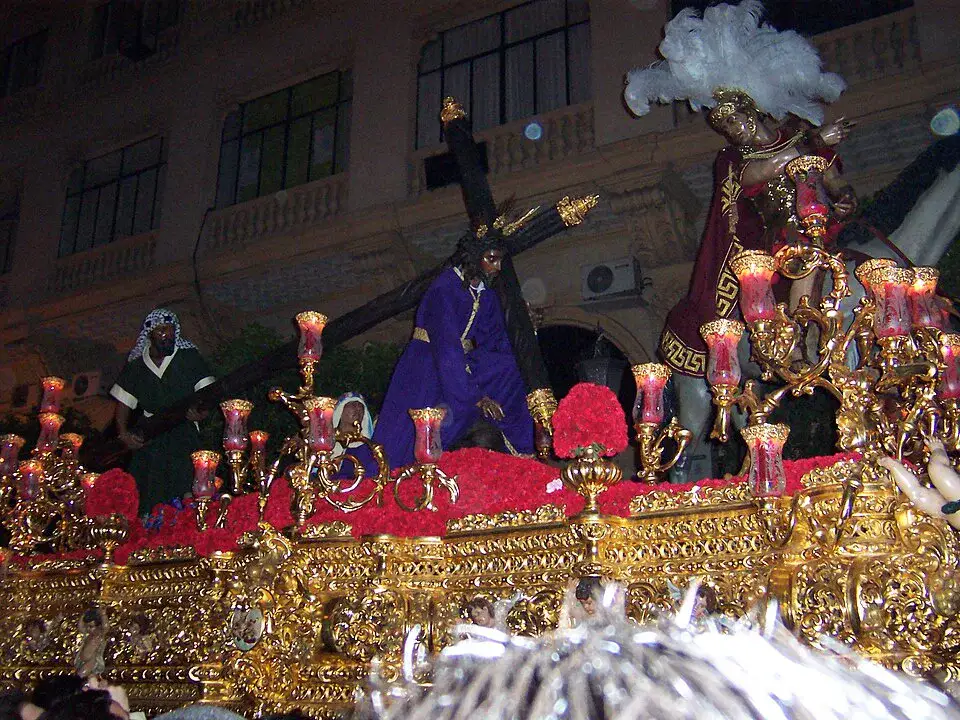
Seville · 21–28 March 2027 · practical travel guide
Holy Week in Seville is not a parade you watch at a set time and then forget about. A brotherhood emerges at the far end of a street, conversations fade, candles catch the light on the façades and a richly carved paso moves forward almost imperceptibly to the sound of a marching band. Around the next corner, ordinary cafés are busy while another crowd has already waited for hours. It is an extraordinary experience, but accommodation, noise and road closures make the difference between a memorable trip and three exhausting days.
What exactly is Holy Week in Seville?
Holy Week (Semana Santa) is the Catholic observance leading up to Easter. In Seville, it is also a centuries-old part of local life. Religious brotherhoods (hermandades) leave their churches to commemorate Christ's Passion, death and resurrection. Members called nazarenos, wearing traditional robes and pointed hoods, accompany the sculptural floats known as pasos, carried by teams of costaleros.
The processions shift between brass bands, candlelit silence and the occasional saeta sung from a balcony. You do not need to be religious to feel their power, but this is a deeply personal tradition for local families—not a show staged for tourists.
Quick answer: when to visit and where to stay
Seville Holy Week runs from Sunday 21 to Sunday 28 March 2027. For three nights, 21–24 March is a balanced first visit with several days of processions. Choose 24–27 March if you want the most intense experience: the Madrugá takes place overnight from Thursday 25 to Friday 26 March. A trip ending early on Thursday the 25th would miss that night entirely.
For accommodation, Santa Justa and Nervión are often the most practical bases for arrivals, late returns and avoiding the most congested historic streets. Arenal or Santa Cruz place you right amongst the processions, at the potential cost of higher rates and noise; Triana offers an excellent neighbourhood atmosphere, provided you understand how its bridges affect your return. Before falling for a picturesque address, compare accommodation for 24–27 March and check how you would actually walk back to it.
Watching the processions along their public routes is free. Reserved chairs and boxes along the Carrera Oficial are a separate purchase, not an entry ticket to the festival.
On this page
Seville Holy Week 2027: the dates that matter
Between Palm Sunday, 21 March, and Easter Sunday, 28 March 2027, Seville's brotherhoods take to the streets with penitents, bands and elaborately decorated pasos carried by costaleros. There is no single parade route or timetable. Each brotherhood sets out from its church and follows its own course, with major sections passing through the shared ceremonial route. The week itself is confirmed; the detailed 2027 departure times, street-by-street routes and last-minute alterations must be checked against the official schedule once published.
The Council of Brotherhoods has already approved the official-route order for Palm Sunday 2027. This is useful advance information for Sunday 21 March, but it is not a complete timetable or a confirmed street-by-street route for every brotherhood. Check the latest procession details shortly before you travel rather than choosing a waiting spot from an old schedule.
| Date in 2027 | Event | Best reason to visit |
|---|---|---|
| Sun 21 March | Palm Sunday / Domingo de Ramos | Dramatic opening day, big crowds, a strong family atmosphere |
| Mon 22–Wed 24 | Holy Monday to Wednesday | A variety of brotherhoods and more ways to pace your trip |
| Thu 25 March | Maundy Thursday | Processions continue into a particularly important evening |
| Overnight 25–26 | La Madrugá | Macarena, Gran Poder, Esperanza de Triana and other famous brotherhoods |
| Fri 26 March | Good Friday | Solemn processions after the overnight celebrations |
| Sat 27 March | Holy Saturday | A different mood and a chance to slow down |
| Sun 28 March | Easter Sunday | The final celebrations and the Resurrection procession |
The Madrugá is not a show that ends at midnight. Some of its processions continue deep into Friday morning. That changes both your hotel choice and your energy levels: a room five minutes from the route can be wonderfully convenient but almost impossible to sleep in if its windows open over a procession.
To understand the tradition, the official Seville tourism guide to Holy Week is a good starting point. For the eventual timetable and any route changes, consult the General Council of Brotherhoods. The latter has already begun publishing specific 2027 arrangements, but that does not amount to a final timetable for every procession.
Which three nights should you book: early Holy Week or the Madrugá?
Sunday 21 to Wednesday 24 March works well for travellers who want genuine processions without organising the entire stay around the biggest night. Be aware, though, that Palm Sunday draws enormous numbers of local people and visitors. It is not a quiet bargain alternative. Its advantage is flexibility: you can enjoy the streets, see several brotherhoods, visit a few sights if they are open, and still have time for proper meals and sleep.
Wednesday 24 to Saturday 27 March is the trip I would choose if Holy Week itself is your main reason for travelling. Wednesday lets you get oriented. You can use Thursday daytime to rest, then focus on one important procession as the evening turns into the Madrugá. On Friday, you'll want a lighter programme. The experience is emotionally richer, but it comes with bigger crowds, difficult walking routes and potentially expensive accommodation.
Thursday 25 to Sunday 28 March also includes the Madrugá and Easter Sunday, although arriving during Thursday's crowds may be less comfortable. It also removes much of your preparation time. If you are considering this option, ensure your arrival transfer and hotel check-in can cope with temporary closures. And if you can only visit on Easter Sunday, understand that it is very different from the dense programme earlier in the week.
Compare two full three-night stays rather than a random weekday room rate with a festival weekend. For the opening days, compare hotels for 21–24 March around Santa Justa or Nervión. A cheaper room far from the action can cost more once late-night detours or taxi fares are factored in.

Where to stay during Seville Holy Week: four sensible bases
The apparent distance between neighbourhoods can be misleading. A procession, crowd-control barriers and stationary spectators can force a long detour, even when your hotel is only a few streets away. I value two possible walking routes back to the room over an address advertised as being “right in the centre”. Ask whether the windows face the street, whether the reception can be accessed late at night, and whether you can reach it without crossing the official procession route.
Santa Justa and Nervión — convenience over postcard scenery
This is the practical choice for many visitors. Santa Justa station makes train arrivals easy; the wider streets and ordinary residential blocks of Nervión can provide more options when the old town is busy. You may have to walk farther to the main processions, but you are less dependent on finding a route across the densest part of the historic centre.
The Ibis Styles Sevilla City Santa Justa is worth comparing if you arrive by train and value predictable access with luggage. It sits on Avenida de la Buhaira, on the edge of Nervión; verify the actual walking distance rather than relying on the word Santa Justa in its name. Farther into Nervión, Hesperia Sevilla may suit travellers who prefer a metro connection and do not mind being a significant walk from the old town. Neither should be called “cheap during Easter” without a quote for your exact dates.
Best for: light sleepers, train arrivals, families and people who expect to retreat to the hotel between outings. Trade-off: you may spend extra time walking, and a metro stop cannot eliminate every procession-related closure.
Santa Catalina, San Lorenzo and Alameda — local character and long nights
Santa Catalina, on the eastern edge of the old town, is rich in churches, little streets and modest squares. San Lorenzo connects you with some of the traditions around Jesús del Gran Poder, while the Alameda area offers an energetic evening food and bar scene. These are excellent bases for travellers who want to understand how each brotherhood belongs to a neighbourhood, not just stand in front of the Cathedral with thousands of others.
The Hotel Don Paco, near Santa Catalina, is an appealing middle ground between a central location and avoiding the smallest lanes of Santa Cruz. It can be a good base if you plan to watch nearby processions. The warning is just as important: in Holy Week, central accommodation can mean the crowd ends up right outside your door. An inward-facing room might be worth paying more for than a street view.
Best for: people who want to walk between churches, squares and processions. Trade-off: late-night noise, complicated access and a possible premium on central rooms.
Triana — a neighbourhood to experience, not merely a cheaper hotel district
Across the Guadalquivir, Triana has its own religious heritage, everyday cafés and the lovely perspectives along Calle Betis and the river. A paso passing near Altozano or the Isabel II Bridge can be unforgettable. Triana is not outside Holy Week, though. Its streets and the bridges linking it to the historic centre can become bottlenecks precisely when you most want to move.
Choose Triana if you actually want to spend time there. A cheaper room on the wrong side of the river can be a false economy if your itinerary sends you back and forth at peak procession times. Look carefully at where you would cross and have a plan that does not depend on a single bridge being easily accessible.
Best for: repeat visitors, food lovers and travellers drawn to Seville's neighbourhood atmosphere. Trade-off: crossings can become much slower than a map suggests.
Arenal and Santa Cruz — maximum atmosphere, maximum logistical friction
The streets around Arenal and Santa Cruz are beautiful, central and often close to important routes. They can also be the hardest to navigate when processions and crowds overlap. Don't assume a taxi can always reach the hotel's front door. A property only two minutes from the Cathedral may require a long walk around barriers, with bags, on arrival night.
Near Reyes Católicos, Hotel Bécquer makes sense for someone who wants pedestrian access to Arenal and the river without a room hidden deep in Santa Cruz's tiny streets. Its appeal is location and flexibility along the river, not a promise of low rates for 24–27 March. The more you value being in the middle of the celebrations, the more carefully you need to check noise and cancellation terms.
Best for: travellers who prioritise atmosphere and the central routes. Trade-off: higher possible rates, crowds, noise and unpredictable door-to-door arrival.

Seville Holy Week 2027 budget: what three nights could really cost
Comparing a single “average hotel price in Seville” is almost pointless during this week. The precise dates, room cancellation rules, distance from a procession and whether there is any stock left can change the answer completely. Instead of claiming to have found deals that may not exist, use the following planning scenarios. Both assume two adults sharing a private double room for three nights from 24 to 27 March 2027; flights and international rail fares are excluded.
| Three-night expense, two adults | Room at €130/night | Room at €230/night |
|---|---|---|
| Accommodation | €390 | €690 |
| Simple meals, snacks and coffees | €150 | €150 |
| Airport or rail transfers and local transport | €35 | €35 |
| Modest sightseeing and contingency | €45 | €45 |
| Indicative total for two | €620 | €920 |
| Per person | €310 | €460 |
Check flights to Seville before committing to a non-refundable room: a cheap flight on a different date can change the full equation. These are calculations, not live room quotations. A private double room at €130 might not be available during the Madrugá, or could be sold out long before March 2027. The example shows the real economics: increasing your average nightly room price by €100 adds €300 to a three-night trip for two, while watching most processions in public remains free.
For a tighter budget, shop for a suitable neighbourhood and consider changing nights before cutting every meal and sightseeing experience. Pay attention to the full price including any tax or service charge, whether a deposit is taken immediately, and whether the room can be cancelled. The cheapest non-refundable room is not necessarily the best value when you have not yet bought your transport to Spain.
Three ways to stop your spending getting out of control
Compare like with like. Do not compare a tempting “from €90” rate outside the festival with a Thursday-night quote. When you have selected 24–27 March, all hotel comparisons should use those exact dates and the same room occupancy.
Price the return journey. An apparently cheap hotel far outside the city may mean extra taxi fares, especially when drivers must stop short of the procession area. A slightly dearer room within a realistic walking distance may be the cheaper trip overall.
Skip reserved seats unless you really want them. Holy Week is not a ticketed city-wide attraction. Official chairs and boxes can be worthwhile for some enthusiasts, but they are optional, and public streets offer remarkable experiences without that cost.
If the Madrugá accommodation prices break your budget, keep 21–24 March in mind as an alternative. It is a different version of Holy Week, not a lesser copy. You may enjoy it more than a busier stay where every spare euro has gone into the hotel.
How to watch the processions for free — without fighting the crowds
The usual mistake is trying to see everything. Instead, aim for one or two brotherhoods per day. Read where each one starts, consider a point near a church or a return stretch, and avoid planning to cross the entire historic centre to catch the next procession. The most affecting moments can happen in an ordinary neighbourhood street, away from the most photographed corners.
Carrera Oficial: why there are paid seats but no general entry ticket
All brotherhoods pass along a shared official route, traditionally beginning around Campana and proceeding towards the Cathedral. The installed chairs and boxes are controlled, allocated and paid for separately. That does not mean you must pay to see the Semana Santa. Along many other public stretches of each procession, spectators can watch for free, subject to barriers, crowd management and access restrictions on the day.
Before paying for a seat, ask yourself whether you would actually use it long enough to make it worthwhile. For a first-time visitor on a budget, following a brotherhood in the streets is often more memorable. For official seating and subscription details, use the Council's seating management website. Do not rely on unverified resale listings or assume 2026 prices will apply in 2027.
Where should a first-time visitor stand?
Look for a stretch that is outside the most compressed intersections, yet not so far from your hotel that returning is difficult. The Cathedral area is spectacular but can leave you trapped between people and barriers. Around Santa Catalina or San Lorenzo, the connection between a brotherhood and the neighbourhood can feel more personal. Near Triana's Altozano and the bridge, the views are wonderful but the crowd can be intense.
Above all, do not treat processions like tourist buses you can chase along the route. The steps are slow, but the crowd moves much more slowly, and policing may prevent you crossing at a convenient corner. If you miss a passage, let it go and concentrate on the next one rather than pushing through.
Listen as well as look. The drumbeats, the silence and an occasional saeta sung from a balcony explain as much about the city as the painted sculptures. This is a religious event lived by local communities; stand back from penitents, leave room for the bearers and avoid flash photography during solemn moments.

Getting to Seville and moving around when streets close
Seville is usually a very walkable city. During Holy Week, however, walking routes become less predictable, especially in the narrow historic centre. A procession route, security barrier or change to a bus terminus may turn a five-minute trip into half an hour. Make your accommodation your anchor and do not schedule transfers down to the minute.
Seville Airport (SVQ) to the city
The EA airport bus is the principal public transport connection between Seville Airport and key city stops including Santa Justa. In ordinary conditions, the journey to central areas takes roughly 30–35 minutes. During Holy Week 2026, the official bus plan allowed parts of the EA service to be restricted around Puerta de Jerez when Paseo Colón was closed. For 2027, check the new TUSSAM operating notice rather than relying on an article that promises a specific final stop no matter what is happening in the streets.
Staying near Santa Justa can make arrival straightforward. A tiny hotel lane in Santa Cruz may require a substantial final walk with luggage, even if you book a taxi. The driver cannot use a street closed for a procession, and hotel “airport transfer” services do not override road restrictions.
Metro, tram and city buses
Seville's metro helps reach Nervión, San Bernardo and wider districts. The Metrocentro tram serves central areas where its operation may be affected by the brotherhood routes; expect temporary changes to services and termini. TUSSAM usually increases capacity at Holy Week but also changes some routes to manage closures. The 2027 special timetable is not yet final, so do not base a late-night return on last year's departure time.
Bookmark TUSSAM and Metro de Sevilla before travelling. An evening spent on one bank of the river and in one neighbourhood is often easier than repeatedly trying to cross town. After the Madrugá, plan extra time and a fallback walking route if you are travelling with children or anyone who finds long periods of standing difficult.
Arriving by train or car
Santa Justa station connects Seville with Madrid, Córdoba and other Andalusian destinations. A railway arrival removes airport transfer uncertainty and can make hotels near the station attractive. If you do drive, use parking outside the old town; arriving at an accommodation entrance in the middle of a procession is often impossible. On some days, even the supposedly quieter edges of the centre are subject to temporary restrictions.
How to make the most of three nights without exhausting yourself
The balanced trip: Sunday 21 to Wednesday 24 March
Arrive on Sunday with enough time to leave your bags but resist the urge to book two timed attractions straight away. Spend the first evening watching a procession within easy walking distance of your accommodation. On Monday, consider the Cathedral or Alcázar only after checking their actual Holy Week opening hours. Religious services can change visitor access, and a booked slot may not fit neatly into a procession day. Leave the afternoon or evening for a brotherhood near Santa Catalina or San Lorenzo, with time for dinner in between.
Tuesday can combine a gentle Triana morning, a market or riverside stroll and a procession with a different character. Do not feel compelled to “do all of Seville” before leaving on Wednesday. The great advantage of this trip is having enough space to notice what happens around you.
The Madrugá trip: Wednesday 24 to Saturday 27 March
Use Wednesday to understand the city: walk the route between your hotel and the area you hope to watch, find at least one alternative way back and have a proper meal before the evening crowd. On Thursday, keep the morning deliberately light. Rest is not wasted time; it is what makes the overnight experience worthwhile.
For the Madrugá, Macarena, Gran Poder and Esperanza de Triana are not checklist items. Choose one priority and study its confirmed 2027 itinerary when available. Arrive before the main crowd, accept a wait and enjoy the experience rather than trying to cover the entire route. On Friday morning, go back to sleep if you need to. Booking full-price attractions at 09:00 after a night in the streets is an easy way to turn a remarkable journey into an unpleasant one. If your Saturday departure leaves enough time, a short riverside walk or one final tapas lunch can round things off without adding travel stress.
Only one day in Seville?
For the rest of your visit, the Seville three-day itinerary offers a relaxed route through the monuments, Triana and the patios; during Holy Week, allow the processions to set the pace instead. A day trip from Córdoba or another Andalusian base can be rewarding, but it is important to focus on one part of the day and one procession area. A late evening procession cannot be combined with a return train that leaves earlier. If the Madrugá is the main reason you are travelling, book at least one night rather than counting on an improvised taxi or an all-night wait at a station.

The mistakes most likely to spoil the experience
Book a room on the route without checking street noise. Wonderful views can mean a sleepless night. Ask for a courtyard-facing room, particularly if you are not planning to stay up for the Madrugá.
Assume every area beyond the historic centre is cheaper overall. Add walking time, possible taxis and missed sleep to your nightly rate. An inexpensive room that is awkward to get back to may not be good value.
Pay for a ticket without understanding what it buys. Chairs and boxes on the official route are optional. You can see numerous processions on free public routes.
Fill the day with museum slots. Religious services can alter access to the Cathedral and other sites. Confirm 2027 visiting schedules before purchasing a fixed-time ticket.
Try to chase every brotherhood. Two meaningful moments in one day are better than six frantic journeys with crowds between you and the procession.
Ignore standing time and accessibility. Bring water, comfortable shoes and rest breaks. Dense crowds and steps can make some stretches particularly difficult for pushchairs and people with reduced mobility.
Forget that rain changes everything. Brotherhoods may cancel or delay outings to protect historic religious objects. Have a market, neighbourhood or cultural alternative ready instead of assuming your chosen route is guaranteed.
Treat worshippers as a backdrop. The participants are not there solely for tourists. Avoid blocking their way or using flash in moments of silence.
Seville Holy Week 2027 FAQ
When is Holy Week in Seville in 2027?
Sunday 21 to Sunday 28 March 2027. Maundy Thursday falls on 25 March and Good Friday on 26 March. Detailed timings for all brotherhoods will be published closer to the event.
When is the Madrugá in 2027?
Overnight from Thursday 25 to Friday 26 March, continuing into Friday morning for some processions. If that is your main reason to travel, your accommodation must include the night of Thursday the 25th.
Do you need a ticket to watch the processions?
No. Watching along ordinary public routes is generally free, although barriers and crowd management apply. Reserved seats and boxes on the Carrera Oficial are paid, optional products.
Where should I stay for a quieter night?
Look at the Santa Justa–Nervión area or residential streets on the edge of the old town, and request an inward-facing room. No central location guarantees quiet when a brotherhood passes nearby.
Is Triana a good place to stay for Holy Week?
Yes, if you want to experience Triana itself. However, bridges and the streets around Altozano can be congested, so it may be less convenient for repeated trips to the Cathedral district.
Do I need a car in Seville at Easter?
No. The historic centre experiences closures and temporary changes to traffic. Walking, metro, city buses and trains are normally more practical, with special 2027 arrangements to be checked before departure.
What happens if it rains?
A brotherhood may delay or cancel an outdoor procession to protect its images and ceremonial objects. Consult the official information on the day and keep an indoor alternative.
Can I visit the Cathedral and Real Alcázar during Holy Week?
Usually at some times, but church services and festival arrangements can restrict visits. Check each attraction's official calendar and available time slots before buying tickets.