Paphos in winter: 4 days in Cyprus, weather, where to stay and budget
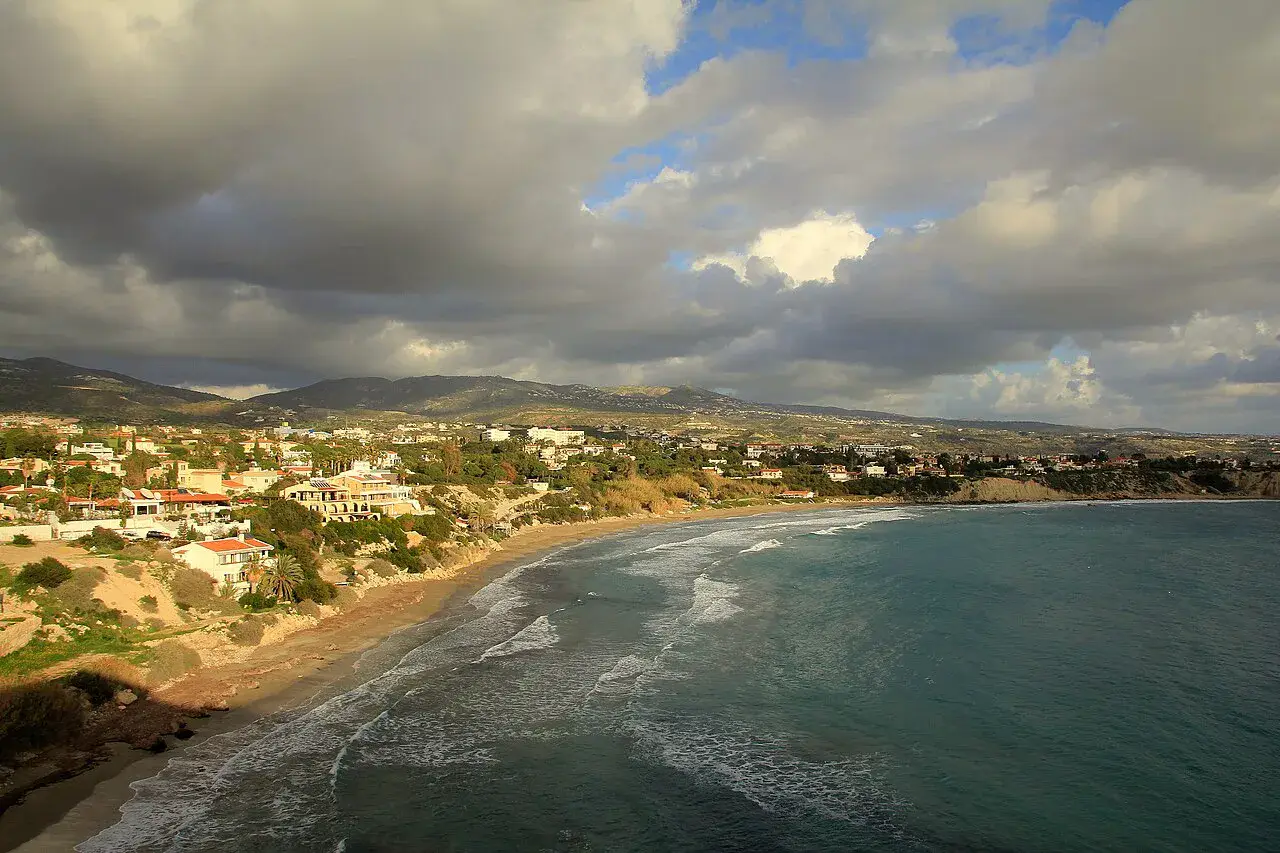
Paphos · Cyprus · 4 days · winter
Paphos is a strong winter destination when you book the right kind of trip. It is not a 25°C beach week: January normals at Paphos Airport sit around 17.7°C by day and 9.4°C at night, rain is genuinely part of the season and Mediterranean water drops to roughly 16–17°C. What winter improves is everything else — Roman mosaics, Tombs of the Kings, long coastal walks and the archaeological landscape around Aphrodite without midsummer heat.
Four days work particularly well because Paphos is more than its harbour. Day one stays in Kato Paphos and the Archaeological Park; day two links the Tombs of the Kings with the Old Town; day three follows the coast towards Coral Bay and the Sea Caves; day four uses the old road towards Kouklia and Petra tou Romiou. The entire itinerary can be done without a rental car, although bus frequencies thin out outside the city.
Our first-trip recommendation: stay in Kato Paphos within easy walking distance of the harbour. You will simplify the first two days, sit on the useful airport bus 612 corridor and remain well positioned for bus 615 towards Coral Bay and 631 towards Aphrodite's Rock.
Paphos in winter in 30 seconds
| If your priority is… | Choose… | Why |
|---|---|---|
| First visit | Kato Paphos / harbour | Archaeology, promenade, restaurants and airport bus on foot |
| Hotel with a genuine winter pool | Tombs of the Kings / northern Kato Paphos | Several large hotels with heated indoor pools |
| Local cafés and city life | Old Town / Ktima | Less resort-like, but you commute down to the harbour |
| Beach above everything | Coral Bay | More resort-oriented, less efficient for Paphos sights |
If you are still choosing a mild January destination, our comparison of winter sun in Europe in January puts Cyprus alongside the Canaries, Madeira, Malta and southern Spain. Paphos is strongest when you want relative warmth + history + four active days, not when maximum temperature is the only criterion.

Paphos weather in December, January and February: what winter really means
World Meteorological Organization climate data for Paphos Airport gives a more useful picture than generic “winter sun” marketing. Days remain mild enough for long walks, but December to February is also the genuinely wet part of the year.
| Month | Avg high | Avg low | Avg rain | Rain days | How to read it |
|---|---|---|---|---|---|
| December | 19.6°C | 11.0°C | 86.5 mm | 10.6 | Mildest of the three, already real winter |
| January | 17.7°C | 9.4°C | 91.5 mm | 12.7 | Core winter: sun, wind and showers can alternate |
| February | 17.6°C | 9.4°C | 73.8 mm | 11.3 | Still cool, first signs of spring |
These are historical averages, not a promise for your week. You may eat lunch outside at 20°C and wear a waterproof jacket the following day. Cyprus Tourism also notes roughly six hours of bright sunshine per day in December and January while acknowledging that showers are part of winter.
Can you swim?
Average sea temperature is roughly 16–17°C from January to March. Some people swim year-round; for most travellers this means a quick dip rather than a long beach afternoon. If daily swimming matters, filter hotels for a genuinely heated winter pool rather than simply selecting “swimming pool”.
Check what “heated” means. Some Paphos hotels heat an outdoor pool only depending on weather; others have a true indoor pool heated through November–March. Verify the exact pool and operating dates before paying a non-refundable rate.
What should you pack?
Bring light layers, a windproof waterproof jacket, shoes that remain comfortable on wet paths and something warmer for evenings. A heavy winter coat is rarely necessary on the coast, but packing only summer clothes is a mistake. Add Troodos and the clothing list changes completely: snow and much colder mountain temperatures are possible.
Paphos Airport: choose the useful bus before choosing the hotel
Two airport routes operate year-round. Bus 612 runs between the airport and the Tombs of the Kings area via Poseidonos Avenue and Kato Paphos hotels. Bus 613 serves Karavella and the upper city. The 2026 timetables include multiple departures through the day and selected late-night services. The network currently displays a €2 standard single fare and €3 night fare.
For this itinerary, 612 is therefore the most useful line. If your room sits near the harbour or Poseidonos Avenue, public transport can remove the airport-transfer decision entirely. Recheck your exact stop and timetable on Pafos Buses: a hotel labelled “Paphos” can sit far from the route you actually need.
When a taxi makes sense: very late arrival with children, three or four travellers sharing the fare, a hillside property poorly served by bus, or an early flight before a useful connection. Otherwise, airport logistics alone do not justify renting a car.
Where to stay in Paphos in winter: location and the pool matter more than in summer
Winter changes hotel value. Being 50 metres from a pretty beach matters less than it does in June; a heated indoor pool, a restaurant that genuinely stays open and a short walk back from the harbour matter more.
Kato Paphos
The best four-day combination: Archaeological Park, harbour, coastal walk, restaurants and several buses. You reduce daily transport and stay in the part of town most useful when seasonal businesses scale back.
Tombs of the Kings corridor
Good for a larger hotel with spa while remaining close to central sights. Harbour walks are longer, but the Tombs and bus 615 become particularly convenient.
For a broad search, start with accommodation in Kato Paphos and inspect the real walk to the harbour. Across four days, saving ten minutes each way can be worth more than a small room-rate difference.
Dionysos Central: choose it for location
Dionysos Central Hotel sits roughly 50 metres from the seafront and minutes from the old harbour. It suits travellers spending the day outside and walking back after dinner. Its main selling point for this itinerary is geography, not a winter-resort facilities list.
Elysia Park: apartment space plus an actual cool-weather fallback
Elysia Park works well for four nights when you want an apartment, kitchen and more space. The property confirms a heated indoor pool in its wellness area and markets a Winter Escape for November 2026–March 2027. The trade-off is location: it is less immediate than the harbour, so decide whether extra walking or occasional transport bothers you.
Elysium: a premium choice that makes specific sense in winter
For a higher-end break, Elysium has an indoor pool heated from November to March and sits close to the Tombs of the Kings. It is not a budget pick, but this is one of the rare upgrades that can materially improve a rainy winter afternoon rather than simply buying a more luxurious bedroom.
What about the Old Town?
Ktima has more local cafés, the municipal market and less resort atmosphere. It is interesting for repeat visitors or travellers prioritising city life over the waterfront. For a first four-day stay, we would still sleep lower down to avoid repeatedly commuting between upper Paphos and the harbour.
4-day Paphos winter itinerary
Day 1 — Kato Paphos, Roman mosaics and the harbour
08:30–12:00 · Kato Paphos Archaeological Park. Start here while the light is good and before any weather change. From mid-September to mid-April, the park currently opens 08:30–17:00 and costs €4.50. Admission covers major remains including the Houses of Dionysos, Theseus, Aion and Orpheus, the Odeon, Agora and Saranta Kolones.
The mosaics alone deserve substantial time, but the site is large and mainly outdoors. In winter that is an advantage: you can walk for hours without July heat. In rain, prioritise the more protected mosaic sections and shorten the outer loop rather than trying to “get your money’s worth” from every ruin.

12:00–14:00 · Harbour and lunch. Leave the park towards the marina, walk to the medieval castle and eat slightly back from the first waterfront row if value matters. The castle is worth seeing from outside; pay to enter only if the view itself matters to you.
14:00–17:00 · Coastal walk. Continue north-west beside the archaeological zone. Winter gives walkers much more room and late-afternoon light can be excellent. Keep the schedule loose: when a shower arrives, a proper harbour café stop is better than sprinting towards a secondary attraction.
If you want more context: a guided historical tour in Paphos can replace part of this first day. Book it for interpretation, not simply to add another reservation to an already full itinerary.
Day 2 — Tombs of the Kings, Old Town and Ktima cafés
08:30–10:30 · Tombs of the Kings. Winter opening is 08:30–17:00 and admission is only €2.50. Despite the name, kings were not buried here; the monumental rock-cut tombs served high-ranking officials and aristocrats in the Hellenistic and Roman periods. The underground courtyards and Doric columns deserve more than a rushed stop.

10:30–12:00 · Extend the coastal walk. Return towards Kato Paphos on foot if the weather is dry, or use the urban network if conditions turn. The goal is not a mileage target; it is using good winter weather when it appears.
12:30–17:00 · Old Town. Move uphill around the municipal market, Kennedy Square and Ktima streets. Bus 610 links the harbour and municipal market, while other urban routes connect through Karavella. Here Paphos feels less like a resort: neoclassical buildings, artisans, cafés, shops and restaurants serving locals year-round.
The Ethnographic Museum is a useful weather fallback. Current visitor information lists €5 admission, 10:00–17:00 Monday–Saturday and 11:00–13:00 Sunday, closed on public holidays. Do not force it into a sunny day; keep it as a smart option when a shower arrives.
Why stay near the harbour instead? Old Town is stronger as a half-day visit than as the default base for a first trip. Most day-one sights, the coast and buses heading west fit Kato Paphos more naturally.
Day 3 — Coral Bay, Sea Caves and Agios Georgios if weather cooperates
This should remain the most flexible day. Check wind and rain in the morning: clear weather makes it your coast day; heavy rain is a reason to swap it with indoor time, Old Town or your hotel pool.
09:00 · Bus 615 towards Coral Bay. Route 615 starts around the Tombs of the Kings corridor and runs very frequently through the day, then every 30 minutes in the evening from December to March. Coral Bay can feel quiet in deep winter, which is part of the appeal: coastal walking, lunch or coffee by the sea, and a swim only if you genuinely enjoy cool water.
11:30 · Continue to the Sea Caves or Agios Georgios. Bus 616B links Coral Bay with Agios Georgios via the Sea Caves and operates year-round with multiple departures every day. It is an unusually useful way to reach a wilder section of coast without a rental car.
Do not ask this day to imitate a summer beach holiday. In January or February it works as a coastal landscape day in soft light. With strong wind or rough sea, stay away from cliff edges and avoid improvised paths to exposed coves.
Akamas in winter: we do not make the Blue Lagoon compulsory. Many tours combine road and boat sections, but winter operation and the appeal of swimming are more variable. If one interests you, confirm that it runs on your exact date and adds more than an hour on a boat above 16–17°C water.
Day 4 — Kouklia and Petra tou Romiou without a car
The final day is surprisingly workable by bus all year. Route 631 leaves Harbour Station, serves Kouklia and continues to Petra tou Romiou — Aphrodite's Rock. December–March departures are less frequent than summer services, but the route continues to operate.
Morning · Palaipafos in Kouklia. The ancient cult centre of Aphrodite complements Kato Paphos’s Roman story perfectly. Current admission to the site and local museum is €4.50. Winter hours are generally 08:30–17:00; official pages differ slightly on Monday operation, so verify the precise day before building the bus connection around it.
Afternoon · Petra tou Romiou. Continue to the coast for the landscape associated with Aphrodite’s birth myth. It is spectacular in lower light, but not an easy swimming beach: pebbles, waves and currents deserve more caution than postcard images suggest.

Bus 631 frequency is the real constraint. Winter has only a handful of departures. Use the Pafos Buses journey planner the day before for Kouklia and Petra tou Romiou. If the connection does not work cleanly, visit one or use a short taxi for the missing section rather than spending the day waiting.
Paphos without a car: how far can you realistically go?
| Journey | Useful route | Difficulty | Our take |
|---|---|---|---|
| Airport → Kato Paphos | 612 | Very easy | Strong reason to stay near the harbour |
| Harbour → Old Town | 610 / urban network | Easy | No taxi required |
| Tombs of the Kings → Coral Bay | 615 | Very easy | High frequency |
| Coral Bay → Sea Caves / Agios Georgios | 616B | Easy | Excellent for car-free coast access |
| Harbour → Kouklia / Petra tou Romiou | 631 | Moderate | Year-round but limited frequency |
| Deep Akamas / Troodos | Tour / rental car | More complex | Do not force it into four days |
The conclusion is straightforward: a car does not improve the first two days enough to justify four days of rental. If you specifically want Akamas, wine villages or Troodos, rent for one day or choose a day trip from Paphos. Let that replace a day in the itinerary rather than stacking it onto an already full schedule.
Realistic budget for 4 winter days in Paphos
Winter can unlock strong accommodation rates, but Paphos is not automatically a low-cost destination. Airfare depends heavily on departure airport and some seafront hotels remain premium year-round. The figures below are therefore planning targets for two adults, four nights, including flights, not official averages.
| Cost for 2 | Controlled budget | Comfort | What moves the price |
|---|---|---|---|
| Return flights | €140–320 | €320–520 | European origin, baggage, connections, holidays |
| Accommodation, 4 nights | €220–380 | €460–800 | Harbour, spa, heated pool, meal plan |
| Food + coffee | €160–230 | €280–400 | Full meze, alcohol, hotel restaurants |
| Transport | €25–55 | €70–140 | Occasional taxi or private transfer |
| Sights / one tour | €30–70 | €100–220 | Independent archaeology vs guided excursion |
| Total for 2 | €575–1,055 | €1,230–2,080 | Flight and hotel explain most of the gap |
The archaeology itself remains remarkably inexpensive: €4.50 for Kato Paphos Archaeological Park, €2.50 for the Tombs of the Kings and €4.50 for Palaipafos-Kouklia. The Department of Antiquities also offers multi-site cards at €8.50 for one day, €17 for three days and €25 for seven days. For this exact route, do the calculation before buying: individual entry to the three core sites is already cheap.
Where to save without weakening the trip
- Do not rent a car for all four days by default. Days one to three work very well with walking and buses.
- Compare hotel and apartment. Four nights make a kitchen useful for breakfast or one simple dinner.
- Pay extra for a genuinely heated pool only if you will use it. Otherwise buy location instead.
- Keep to one major guided excursion. The archaeological sites provide enough content without filling the trip with tours.
- Compare the complete airfare. A slightly higher fare into PFO with useful timings can beat flying to Larnaca and adding a long cross-island transfer.
Use our flight comparison page to compare baggage, timings and full journey cost. On a four-day break, losing half a day to the wrong arrival airport can cost more than a small airfare saving.
December, January or February: which month is best?
Mildest
Average highs approach 20°C, although rain is still common. Good before Christmas or just after when flights remain sensible.
The quietest winter version
Excellent for archaeology and long walks, with more rain risk. This is when an indoor hotel facility adds the most value.
Our slight favourite
Still winter, but nature begins moving towards spring, almond blossom appears on the island and daylight gradually improves.
If long swims and outdoor dinners every evening are the real objective, move the trip towards October instead. Paphos stays warm while avoiding part of the summer pressure; our guide to where to go in Europe in October on a budget compares it with other Mediterranean options.
What to book — and what can wait
Flight + the right base
Kato Paphos simplifies almost the whole trip. Use a cancellable room if booking far ahead, particularly when a heated pool is an important requirement.
Day 3 on the coast
Coral Bay and the Sea Caves improve dramatically in clear weather. Keep room to move this day according to wind and rain.
The major archaeological sites do not require weeks-ahead reservations. A guided excursion may deserve advance booking if it is your one Troodos or Akamas day and the operator confirms genuine winter operation.
Paphos winter FAQ
Yes for archaeology, walking and relative warmth. Normal January daytime highs are around 17.7°C, but January is also among the wettest months. It is not guaranteed beach weather.
Yes, but sea temperatures sit around 16–17°C from January to March. A heated indoor pool matters much more if swimming every day is part of the holiday.
Yes. Two days cover Paphos and its core archaeology, one reaches the Coral Bay coast and a fourth handles Kouklia/Aphrodite's Rock. Add nights for deep Akamas or Troodos.
No for this itinerary. Routes 612, 610, 615, 616B and 631 cover the airport, city and chosen day trips. A car becomes useful for villages, deeper Akamas or a wider Cyprus itinerary.
Kato Paphos for a first visit. Harbour, Archaeological Park, promenade and several buses are easy to reach. The Tombs of the Kings corridor is good for large spa hotels; Old Town is better for a more local urban feel.
Some seasonal businesses reduce hours or close, especially in highly resort-oriented areas. Kato Paphos and the city still operate year-round. Confirm hotel restaurants and leisure facilities directly when they matter to your booking.
The Canaries generally deliver warmer, more stable beach weather. Paphos is stronger when you want archaeology, coast, food and weather mild enough for active sightseeing.
Verdict: Paphos works better as an active winter trip than a beach holiday
Paphos is interesting in winter precisely because it does not need 28°C to work. Mosaics, Tombs of the Kings, Old Town and Palaipafos fill days when the sea feels too cold. When a clear weather window appears, Coral Bay, the Sea Caves or the harbour promenade immediately provide the Mediterranean element you travelled for.
For four days, we would stay in Kato Paphos, use buses instead of a rental car and keep day three flexible around the forecast. A heated pool is a valuable bonus if you genuinely swim; it should not justify a badly located hotel when you plan to spend most of the trip outside.
The result is relatively rare in Europe in January or February: major ancient sites without intense heat or crowds, a bright coast and very low sightseeing costs. The only adjustment is accepting that “winter sun” means mild outdoor weather and opportunities, not guaranteed summer.
Some accommodation or activity links may be affiliate links at no extra cost to you. We use them only where they follow a real travel decision. Weather, opening hours, prices, access rules and bus frequencies were checked in 2026 but can change; verify details for your exact dates before payment.