Agadir in February: Weather, Surf, Itinerary and Budget
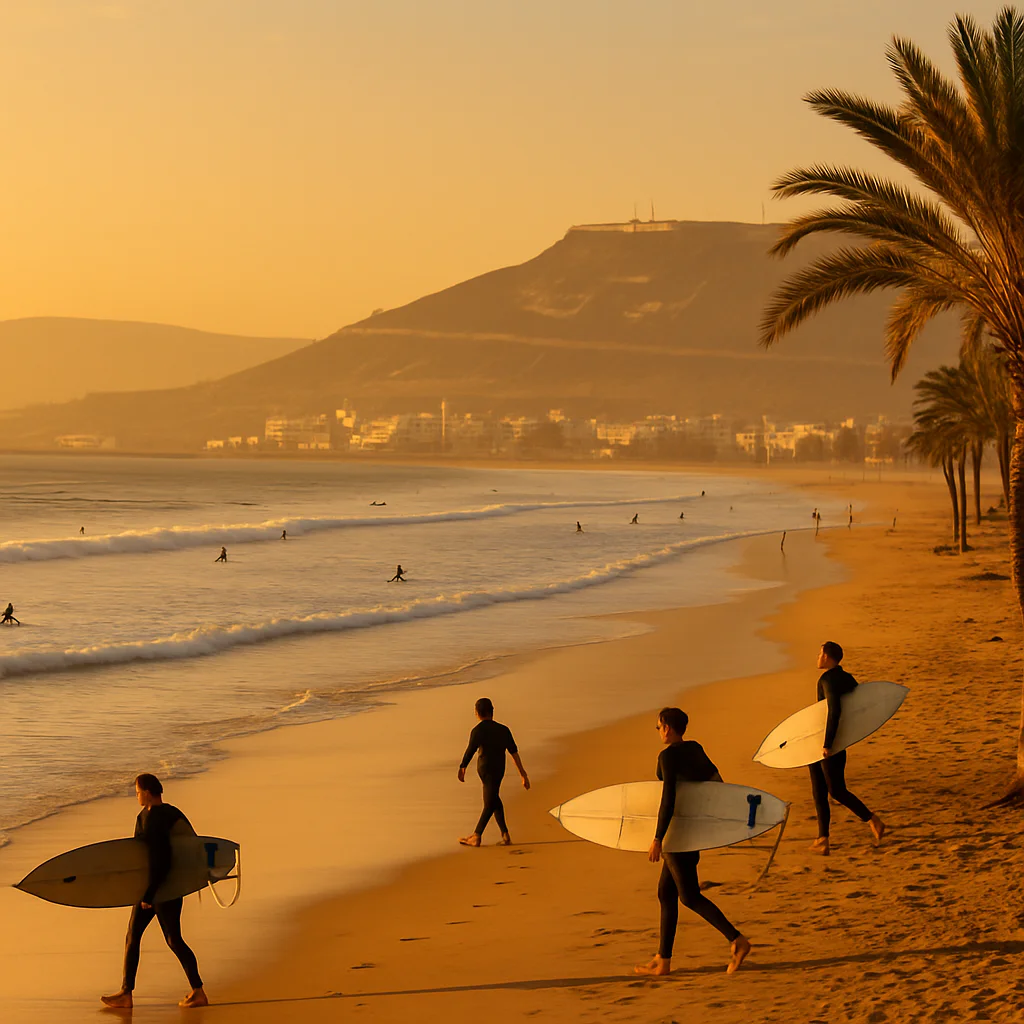
Agadir in February often provides what a European winter has lost: clear light, afternoons that allow walking in a light shirt and an immense beach facing the Atlantic. It does not automatically provide warm sea. The water remains cool, wind can rise and evenings require a jacket. That distinction separates a successful break from disappointment manufactured by a photograph of a pool.
The city is modern, spread out and easy to use, but it does not contain Marrakech’s historical medina. Its appeal comes from the combination: promenade, beach, souk, reconstructed kasbah, fish cooking, surf to the north and excursions towards the valleys of the Anti-Atlas. Taghazout offers a more compact, wave-focused atmosphere; Agadir gives you greater choice, transport and alternatives when conditions change.
This guide builds a realistic five days between the two. It explains where to stay, what kind of beach time to expect, how to choose a surf lesson and why Paradise Valley should remain a landscape excursion rather than a promise of pools that are always full.
Who should choose Agadir in February?
Agadir suits travellers who want to alternate rest, walking, surfing and short outings without hiring a car. Families appreciate the flat seafront and serviced hotels; beginner surfers find schools around Taghazout and Tamraght; culturally focused travellers should understand that urban heritage is more limited than in Marrakech or Essaouira.
Our verdict: choose Agadir for a bright and active winter week, not to guarantee five days in swimwear. A genuinely heated, wind-sheltered pool may matter more than one additional hotel star.

February weather, wind and swimming
Afternoon temperatures frequently move above 20°C when sunshine dominates, but an average promises nothing for your dates. Cloud or wind can make the beach feel cool, especially in shade. The change after sunset is quick. Pack a warm layer, a light windproof jacket and sun protection: gentle air can hide strong ultraviolet exposure.
The Atlantic is generally around 17°C in winter. Some people swim, while others prefer a wetsuit or heated pool. Read flags, swell and lifeguard instructions; a long sandy beach is not a swimming pool. Children should not be left beside forceful shore break because the water appears shallow.
Before booking a hotel: “outdoor pool” means neither heated nor pleasant in February. Ask for the intended water temperature, heating dates and wind exposure, then read reviews written in the same month.
Should you stay in Agadir or Taghazout?
Agadir is the simplest first base, with airport transport, varied restaurants, the long promenade, Souk El Had and excursion departures. Its tourist district can feel generic, yet the convenience becomes valuable with children, a late arrival or when you want to alternate activity and rest without organising every meal.
Taghazout, roughly twenty kilometres north, lives around surfing. The village is more compact, terraces face the ocean and schools are numerous. It is also steeper, more dependent on taxis or buses for Agadir and sometimes noisy around group accommodation. Tamraght, set slightly back, can balance surf houses and more space, but check the real walk to the beach on a map.
| Base | Choose it for | Drawback | Profile |
|---|---|---|---|
| Agadir | beach, services, souk, families | less intimate atmosphere | first visit |
| Taghazout | surf, ocean, village life | transfers and steep streets | couples, surfers |
| Tamraght | surf houses, value, longer stays | beach distance varies | independent travellers |
Founty or central beach
Founty has large hotels; the centre is closer to the souk and restaurants. Measure the walk to the promenade.
Village or developed bay
The village gives atmosphere; the bay has more resorts. Confirm whether daily transport is included in a surf camp.

From Agadir airport to the centre
Al Massira airport lies inland. ALSA’s AE Aerobus links the airport and Agadir on a published schedule, with tickets available on board or at its airport office. At the time of our check, the operator stated roughly fifty minutes, 50 MAD one way and 80 MAD return. Information changes: use the official page on the travel day and identify the nearest stop to your hotel.
A private transfer or taxi makes sense for a late arrival, several children, surfboards or accommodation in Taghazout. Confirm the total price, number of bags and exact destination before departure. Never compare a taxi to Taghazout with a bus ticket into central Agadir; they are not equivalent journeys.
Schedules and fares: official ALSA airport shuttle page. Save the page and your accommodation address before landing.
Agadir itinerary for February
Promenade, beach and a first reading of the city
After arriving, walk one section of the waterfront rather than trying to complete the whole bay. Understand the distance among hotel, beach and restaurants; large resort plots can make the map deceptive. If the sea is calm, walk barefoot near the water. When wind rises, use the promenade instead of insisting on a cold towel.
In the late afternoon, look towards Agadir Oufella hill. The city rebuilt after the 1960 earthquake becomes easier to understand when the kasbah appears above the modern plan. Choose fish or Moroccan cooking for dinner without ordering an entire tasting menu on the first night. Portions and accompanying bread often make sharing natural.
Souk El Had, the centre and Agadir Oufella
Enter Souk El Had in the morning while you still have energy to compare. The market is vast and organised into sections for spices, produce, crafts, clothing and domestic goods. Ask the price calmly, assess quality and avoid food or cosmetic products with unclear ingredients. Bargaining requires neither performance nor a purchase.
After lunch, climb to Agadir Oufella using the available official transport at the time of your stay. The panorama over port and bay is the main reward. Reconstruction and site management evolve; respect closed areas and the memorial character of the old city. Descend before dark when your return transport is not certain.


Taghazout and a first surf session
Book a lesson if you are a beginner, even when you have rented a board elsewhere. Suitable breaks change with swell, tide and ability; an easy beach one day may not be easy the next. A good school supplies a suitable wetsuit, explains currents, chooses the break and limits group size. Ask how long you will spend in the water, whether transport is included and what insurance applies.
Stay in Taghazout after the lesson instead of leaving immediately. Walk through the village, eat lunch facing the ocean and watch experienced surfers without copying them onto a reef. Decide the return to Agadir before the end of the day. If surfing holds no interest, use Taghazout as a coastal half-day and keep the afternoon for a well-reviewed hammam.
Paradise Valley and the Honey Road, without promised swimming
Paradise Valley is a rocky inland landscape, worthwhile for the road, villages, argan trees and contrast with the bay. Pool levels depend on rainfall and season; old images or photographs after heavy rain do not describe your day. Choose an excursion that states the walking, shoes, lunch and time on site.
Never jump from rock without supervision and reliable knowledge of depth. Stagnant water, slippery stone and heat can alter the experience. In February, a measured walk and tea in the valley may be more valuable than forced swimming. When inland weather is poor, substitute a city or surf day according to coastal conditions.

A free day or the long version of Imsouane
For a restful trip, stay in Agadir: beach in the morning, massage or hammam, a late lunch and final walk. The simple day balances the transfers on days three and four. You can also return to Taghazout for a second lesson if the first created a genuine desire to improve.
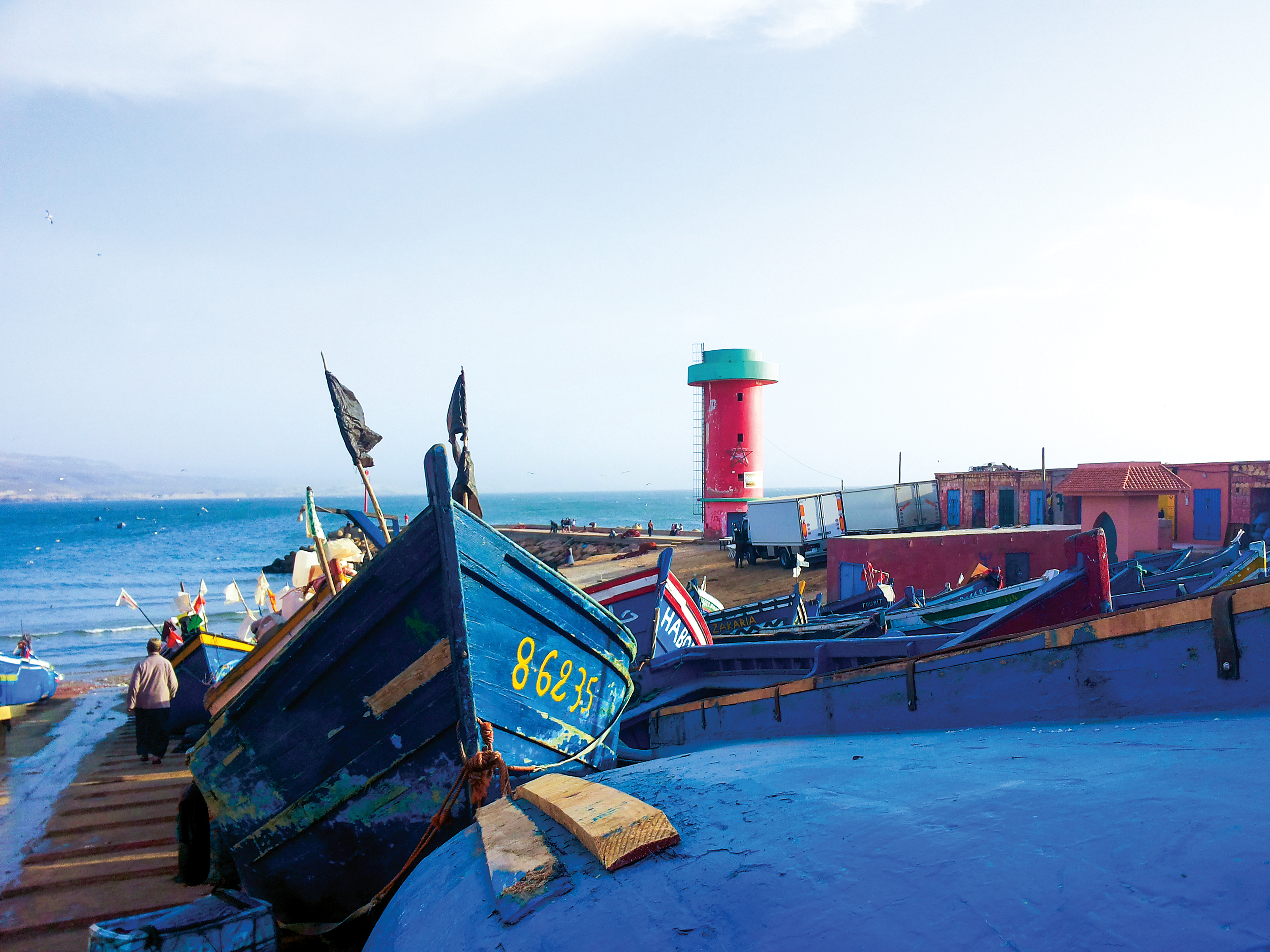
Imsouane is an alternative for committed surfers, not a light outing. The road north is long and shared transport may limit time in the bay. One night is often more coherent than a rushed return. Before booking, confirm pickup, driving duration and the level of the proposed break. Do not add Imsouane solely to photograph the bay.
Surfing in February without overestimating yourself
Winter brings regular Atlantic swell and attracts experienced surfers. It does not make every break suitable for beginners. Serious schools move students to a beach and tide appropriate to the day. They do not place a first lesson at Anchor Point merely because the name is famous.
Ask for the instructor-to-student ratio, a sound wetsuit and an explanation of priority rules. Use sun protection in the water. If you already surf, seek local advice on rocks, currents, access and lineup etiquette. Renting a board does not provide knowledge of the break.
Fish, tagines and responsible choices
The port and markets underline the importance of fish, but quality and pricing vary by restaurant. Ask what is fresh, how the price is calculated and which sides are included. Alternate grilled fish, tagine, couscous when served, soups and daily cooking instead of finding a different “traditional restaurant” every night.
Culinary argan oil is not the same as a cosmetic product. A cooperative visited during an outing can explain production, but its demonstration creates no obligation to buy. Read the ingredients, compare volume and avoid medical promises. At the souk, dates, almonds, spices and amlou are easier to appreciate in small quantities.
What if your trip overlaps with Ramadan?
Ramadan shifts through the calendar every year. It should never be described as a permanent feature of “February”. When dates overlap, tourist zones generally continue to serve visitors, but hours, transport and the working day may adjust. Late afternoon becomes quieter before the fast breaks, followed by more animated evenings.
Respect people who fast without inventing rules. Be discreet with food and drink in strongly local public settings, ask about hours and remain patient. Verify the exact year using reliable sources and your accommodation rather than reusing an old calendar.
Small habits that make the trip more respectful
Resort Agadir can make the transition from home feel almost invisible, but you are still a guest in a Moroccan city. Ask before photographing people at the souk, dress for the setting rather than only the hotel pool and learn a few greetings. Politeness will not remove every sales approach, yet it changes many ordinary exchanges.
Alcohol is available in some licensed hotels and restaurants, not everywhere and not as a default part of a meal. Confirm before travelling across town for a particular venue. Public displays, noise and swimwear that are unremarkable inside a resort may feel out of place in residential streets. None of this requires anxiety: notice the people around you, follow local cues and treat a market, mosque exterior or fishing beach as a lived space rather than a stage.
A realistic budget for five nights in Agadir
Ranges are per person, based on a shared double room and before flights. Half board can work when the pool is genuinely heated and the location isolated; in the centre, paying for every hotel meal needlessly reduces choice. Compare the total, drinks, transfers and included activities.
| Cost | Lean | Balanced | Comfort |
|---|---|---|---|
| 5 nights | €145–250 | €250–450 | €450–850 |
| Transfers and transport | €25–50 | €50–100 | €100–200 |
| Food | €100–165 | €170–280 | €285–470 |
| Surf and excursions | €55–110 | €110–220 | €220–420 |
| Total before flights | €325–575 | €580–1,050 | €1,055–1,940 |
Five February traps to avoid
Choosing a hotel only for its pool
Ask whether it is heated, to what temperature and during which dates. A photograph answers none of those questions.
Promising a Paradise Valley swim
Water levels vary. Book for landscape and walking; treat swimming as a conditional possibility.
Treating Taghazout as an Agadir neighbourhood
The journey is easy but real. Sleeping north changes dinners, transfers and access to the souk.
Surfing a famous break above your level
Choose the school and instructor before the name of the wave. Rocks and currents do not become easy because a spot is photogenic.
Copying Ramadan information from another year
The lunar calendar moves. Confirm dates and adaptations for the exact stay.
FAQ: Agadir in February
Often for walking, reading or lunch in midday sun. Wind and cloudy periods can make lying still feel cool.
Some travellers do, but the Atlantic is cool. Follow safety signs and choose a heated pool if daily swimming is essential.
Taghazout or Tamraght place you near surf schools and the scene. Agadir has more services, while many schools arrange transport to the appropriate break.
Not for five days of beach, souk, Taghazout and one excursion. It becomes useful for an independent route deeper into the interior.
No when you alternate rest, surfing and an outing. For purely cultural sightseeing in Agadir, two days are enough; the coast and interior give the stay its depth.
What to recheck
Use ALSA for the airport shuttle, local flags and instructions for swimming, and your school for swell and surf location. Schedules, fares, religious calendar and valley water levels change and must be checked for the actual dates.
Agadir works when you travel for light, not the tropics
In February, the bay offers long walks, often generous sunshine and easy access to surf and inland landscapes. Choose Agadir or Taghazout according to your rhythm, protect yourself from wind and keep swimming conditional. The trip then becomes more credible — and usually more enjoyable — than the promise of manufactured summer.
Transparency: some booking links are affiliate links. Using them may support LowCostWings without changing the displayed price. Recommendations remain grounded in real conditions, safety and the coherence of the stay.