Cheap 7-Day Europe Itinerary: Prague, Vienna and Budapest by Train
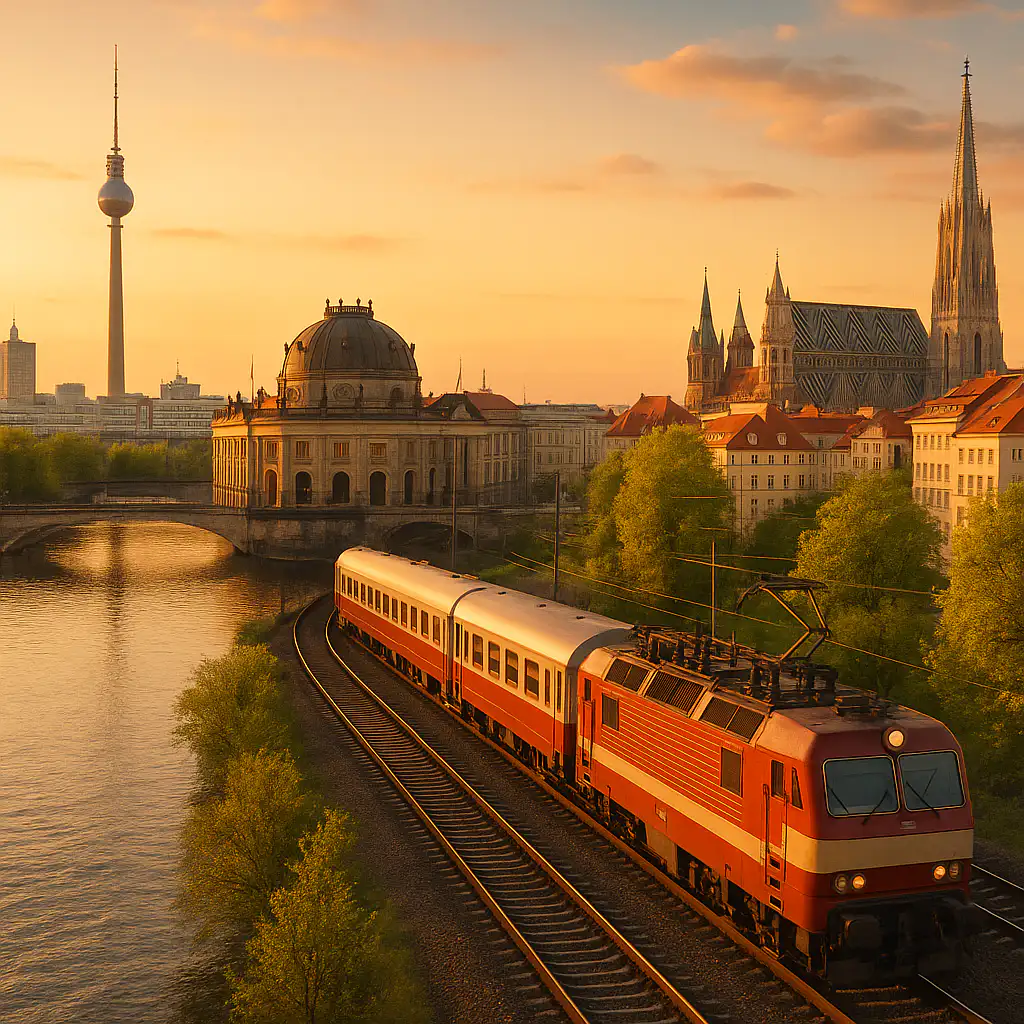
In seven days, three well-connected cities beat a six-capital transport marathon
Linking Berlin, Prague, Vienna, Budapest, Kraków and Warsaw in seven days may fit on paper, but the trip quickly becomes a sequence of stations, hotel changes and early departures. A more balanced route uses two nights in Prague, two in Vienna and two in Budapest, with two direct trains and an open-jaw flight. If you are considering replacing a daytime leg with a sleeper, our night trains in Europe guide shows which routes genuinely make sense.
The route is simple to organise: fly into Prague and home from Budapest, choose three rooms close to transport and add only activities that require a time slot. Every city receives one full evening, one full day and a final morning or arrival afternoon.
The decision in 30 seconds
Choose this route for several capitals without a car when two hotel changes are acceptable. If repacking is a burden, keep Prague and Budapest for three nights each and remove Vienna.
Verdict: Prague–Vienna–Budapest is the strongest first budget multi-city week because journeys are short, direct and central. Berlin and Poland belong to a second trip.
Contents
- The decision in 30 seconds
- Where to stay: choose the area before the hotel
- Getting there and moving around without a car
- Day-by-day itinerary
- Options for different flight times
- What to book and what to keep flexible
- Realistic budget
- Season, weather and backup plan
- Continue planning the trip
- Mistakes to avoid
- Frequently asked questions
- Useful official sources
Where to stay: choose the area before the hotel
Stay within fifteen minutes of the station or a direct line, not necessarily beside every monument. A poorly connected central hotel can force a taxi on train morning.
Book all three rooms with free cancellation, then check again when rail sales open. Assign Friday and Saturday to the city offering the best accommodation-to-evening value.
Prague: Nové Město or Karlín
Nové Město simplifies station and centre; Karlín can improve value with direct metro. Do not pay only to face the Astronomical Clock.
Vienna: Hauptbahnhof or Neubau
Hauptbahnhof wins for rail; Neubau adds cafés and evenings. Stay by the U-Bahn rather than far outside without a simple connection.
Budapest: Belváros or quiet Erzsébetváros
Belváros reduces transport; the Jewish Quarter adds food and nightlife but needs a secondary street for sleep.
Prague + Budapest only
Three nights in each city and a direct or overnight train. Best for couples, remote workers and first rail trips.
Before payment: exact station route, post-8pm check-in, luggage storage, lift and breakfast. Include three local taxes in the budget.

Getting there and moving around without a car
Search an outbound flight to Prague and return from Budapest in one multi-city query. A cheaper same-city return can add a backtracking train, safety night and lost day, so compare complete cost including bags.
Prague–Vienna and Vienna–Budapest normally have direct services. Buy through official operators, compare exchange conditions and avoid a tight connection on flight day. Timetables and works change; this is a method rather than a promised departure.
- Train days: leave after breakfast and arrive early afternoon.
- Tickets: compare ČD, ÖBB and MÁV by segment, then use the chosen official channel.
- Interrail: compare against two point-to-point fares plus reservations.
- Luggage: a soft cabin-size bag simplifies platforms, stairs and storage.
- Car: unnecessary between the capitals and expensive for cross-border one-way rental.
Two direct trains and an open-jaw flight are the cleanest structure. Night buses and secondary airports only win after transfers and fatigue are priced.
Day-by-day itinerary
The two rail journeys become transition half-days rather than lost days. Leave after breakfast, arrive early enough to drop your luggage and preserve the evening. Always confirm the official timetable before fixing timed visits.
Arrive in Prague and take an unbooked orientation walk
Drop your bags, cross Nové Město and reach Old Town Square. Continue towards Charles Bridge in the afternoon without committing to a timed museum.
If the flight lands late, keep only the riverfront, one central street and dinner. Charles Bridge and the castle can wait: an arrival day is not a full sightseeing day.
Eat away from the main square and check the route to Praha hlavní nádraží. Ten minutes of preparation prevents a rushed taxi on departure day.
Prague Castle, Malá Strana and the right-bank districts
Reach the castle early. Choose the interiors that genuinely matter to you, then walk down through Malá Strana rather than returning immediately by tram.
Use the second block for the Jewish Quarter, the National Museum or a long Nové Město loop. Two substantial areas are enough to keep the day enjoyable.
Return to the river or choose a clearly identified concert. Book only when the venue, duration and programme deserve a fixed evening.
Prague morning, direct train and a first Vienna evening
Stay near the hotel or station for a market, café, passage or short museum. Avoid any admission ending less than two hours before the train.
Direct Prague–Vienna services normally run about every two hours. ČD publishes a best journey time of roughly 4 hours 4 minutes, but keep extra time for luggage and the platform.
In Vienna, leave the bags and walk around the Ring, cathedral and central streets. This orientation makes the following full day much easier.
One major collection, one palace and a lived-in Vienna district
Choose Schönbrunn for imperial rooms and gardens or the Belvedere for a more central art-led visit. Do not schedule both major sites back to back.
Add a Ring museum, Naschmarkt or Neubau. A proper café break should replace a secondary sight, not be squeezed between two queues.
Pick a known concert, dinner in Neubau or an illuminated walk. For a performance, verify the actual venue rather than trusting the word “concert” alone.
Final Vienna morning, direct train and the Budapest riverfront
Stay on an easy route to Hauptbahnhof: market, Karlskirche, the Belvedere exterior or a café. Collect the luggage before lunch for an early-afternoon train.
ÖBB publishes direct hourly Railjet or EuroCity links between Vienna and Budapest. Check the arrival station carefully because Budapest has several terminals and the hotel transfer changes with the service.
Start beside the Danube between Parliament and Chain Bridge. A short cruise can work, but a free walk gives more flexibility after the journey.
Buda in the morning, Pest later and an unhurried thermal bath
Reach the Castle District before the main groups, then descend towards the river. Fisherman’s Bastion, lanes and viewpoints already make a complete half-day.
Cross to Pest, choose Parliament, the Great Synagogue or the House of Music, then give the baths a real time block. Two relaxed hours beat an entry trapped between reservations.
Choose Hungarian dinner, a quieter bar or a cruise according to the weather. Finish near a direct route back to the hotel.
Match Budapest to the actual departure time
Add the Central Market Hall, Jewish Quarter or a compact museum, then have lunch before collecting the bags. Leave with the margin recommended by the airport.
Keep only a café, short walk and nearby viewpoint. No timed ticket should put the airport transfer at risk.
Treat the day as departure. A room on a direct transport line and breakfast prepared the night before are more valuable than one extra attraction.
Realistic pace: one booked priority in each city, one district half-day and a genuine daily break. If a flight removes more than half a day, drop one major visit instead of compressing the complete programme.

Four versions for different arrival and departure times
Prague arrival before 1 pm
Keep Old Town, Charles Bridge and one riverbank for day 1. Day 2 can then hold the castle and Jewish Quarter without rushing.
Arrival after 6 pm
Treat day 1 as an evening. Keep the castle on day 2 morning, then choose either the Jewish Quarter or Nové Město rather than forcing both.
Budapest departure after 5 pm
The Central Market Hall or a compact museum fits into the morning. Leave bags at the hotel and confirm the airport route the previous night.
Departure before noon
Do not count any day 7 sightseeing. If a very early flight requires an expensive taxi, compare a later departure or a seventh night before booking.
With seven nights: add the extra night to Budapest for an easier departure or to Vienna for a slower cultural stop. Do not add a fourth city merely because one night is available.
What to book and what to keep flexible
Accommodation and transport drive this route. Limit activities to one priority per city so two rail journeys do not break a rigid programme.
Castle or Jewish Quarter
Reserve only when included content matches priorities. Strong outdoor routes remain available without a combined ticket.
Belvedere, Schönbrunn or concert
Choose one major reservation and verify entry time or the exact concert hall.
Thermal baths
Timed access helps in busy periods. Compare atmosphere, cabin access and duration.
Danube cruise
Light and weather support a late cancellable booking.
Order: open-jaw flights, three cancellable rooms, trains when sales open, then one activity per city. Never buy inflexible rail before securing nights.
Realistic budget
The flight headline is misleading. A €30 saving can add airport transfer, paid bags and a safety night. Calculate door-to-door over six nights.
Swipe the table horizontally on mobile.
| Item | Tight budget | Comfort | Watch |
|---|---|---|---|
| Open-jaw flights | €120–230 | €230–380 | Bags and airports |
| 6 nights / person | €150–260 | €300–520 | Friday, Saturday, centre |
| 2 trains | €45–90 | €90–150 | Late purchase |
| Food | €130–200 | €240–360 | Vienna and central areas |
| Visits and local transport | €70–130 | €160–280 | Baths, palaces, concerts |
| Total | €515–910 | €1,020–1,690 | Per person |
To stay below €700, travel Sunday–Saturday, buy rail early, choose simple metro-adjacent rooms and keep paid visits to three.
Season, weather and backup plan
April to June and September to October balance daylight and temperature, though May holidays can be expensive. Summer adds heat and crowds; winter can lower rates outside festive dates and strengthens museums, cafés and baths.
The route tolerates imperfect weather. Move bridges, viewpoints and cruises to the best windows rather than following a fixed schedule.
March–April
Potential value, variable weather and Easter to watch.
May–June
Long days, stronger demand and earlier booking.
September–October
Excellent climate, light and city rhythm.
November–February
Museums, cafés and baths; avoid major events when budget comes first.
Mistakes to avoid
Adding Berlin, Kraków and Warsaw
Six cities in seven days leaves only transfers.
Booking a Prague return
Backtracking from Budapest may erase the saving.
Choosing secondary airports
Transfers add money and time at both ends.
Staying far from stations
Three check-ins make each detour costly.
Booking two activities daily
One delayed train breaks the plan.
Buying a pass without calculation
Two point-to-point tickets can be simpler.
Frequently asked questions
Yes for Prague, Vienna and Budapest with two nights each, not six capitals.
Use the cheaper open-jaw direction; trains work both ways.
Compare pass plus reservations with two direct fares.
Yes once dates are fixed for lower fares and adjacent seats.
Yes. Three nights each in Prague and Budapest are slower and often cheaper.
Roughly €520–700 with flexible dates, light bags, simple rooms and limited activities.
Useful official sources
Final verdict
Keep three cities, six nights and two direct trains. The route provides enough variety for a week in Central Europe without becoming a transit marathon.
Berlin, Kraków and Warsaw deserve a second trip: adding them here would create more station time without making the week more rewarding.
Transparency: some accommodation and activity links are affiliate links. LowCostWings may receive a commission if you book after using them, at no extra cost. Budget bands are search targets rather than guaranteed prices.