Cheap Places in Eastern Europe: 10 Destinations and Realistic Budgets
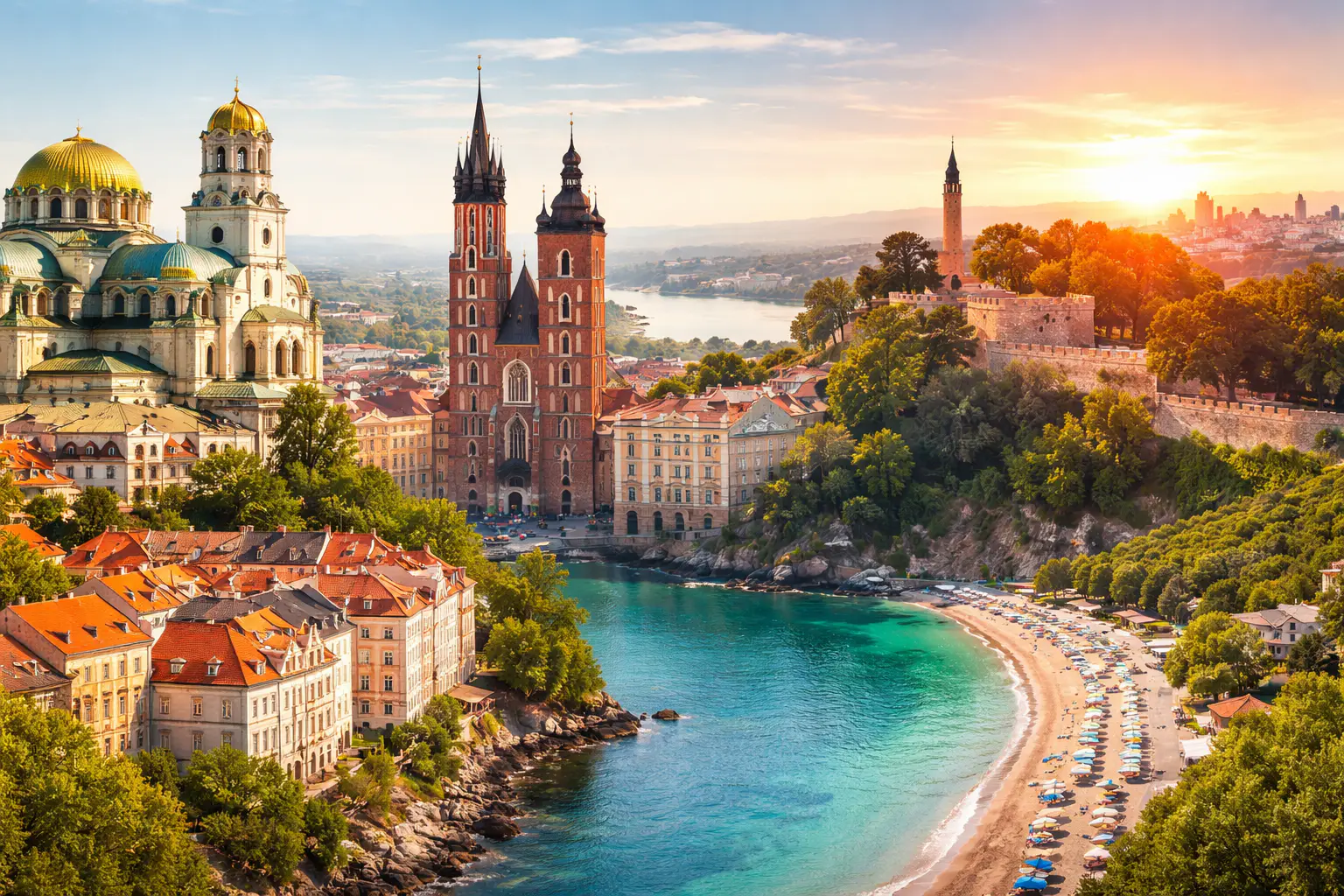
The cheapest country does not necessarily produce the cheapest trip Searches for cheap Eastern Europe often lead to distorted rankings: a lunch price is compared while flights are ignored, a February hostel is set against an August hotel, or “Eastern Europe” is applied to everything from the Baltic to the Balkans. On a short break, transport and district can outweigh the daily difference between two capitals.
This comparison covers ten destinations across Central, Eastern and Balkan Europe for a city break or week: Krakow, Gdańsk, Budapest, Bratislava, Prague, Sofia, Bucharest, Sarajevo, Tirana and Skopje. The geographic label follows practical search intent, not an imposed cultural definition. Every city uses the same frame: shared accommodation, mixed meals, urban transport and one paid activity.
Budgets are per-person daily planning ranges excluding flights. Weekends, festivals, holidays, baggage and late booking can reorder the list. The right choice is the place whose door-to-door cost, weather, mobility and substance fit your trip.
What a daily budget includes — and hides
Ranges combine half a double room or comfortable hostel, two simple meals plus an intermediate dinner, urban transport, coffee and a share of admission. They exclude flight, shopping and distant excursions. A solo hotel guest pays more; two people sharing rooms and transfers lower the unit cost.
Compare identical dates, baggage and districts of similar quality. Add airport travel, any late-night transfer and a visit you will actually take. A €35 flight landing at midnight may require taxi and extra night; a €90 daytime flight to a well-connected city can cost less overall.
Season changes everything. Prague in December, Gdańsk in July and Budapest during an event do not resemble a February weekday. Shortlist three places, price transport, three nights and transfers, and only then apply the daily budget.
Swipe horizontally on mobile.
| Destination | Daily budget* | Flight access | Car-free | Strong profile | Cost risk |
|---|---|---|---|---|---|
| Krakow | €45–85 | Often strong | Excellent | Heritage + evenings | Weekends |
| Gdańsk | €50–90 | Variable | Excellent | History + Baltic | Summer / Sopot |
| Budapest | €55–100 | Very strong | Excellent | Baths + Danube | Central rooms |
| Bratislava | €50–90 | Vienna possible | Excellent | Compact 48 hours | Flight/transfer |
| Prague | €60–110 | Very strong | Excellent | Architecture | Advent and centre |
| Sofia | €40–75 | Origin-dependent | Good | Culture + mountain | Excursions |
| Bucharest | €45–85 | Often strong | Good | City + nightlife | Dispersed travel |
| Sarajevo | €40–80 | Fewer nonstops | Good centrally | History + food | Flight and transfer |
| Tirana | €45–90 | Growing | Good in city | Energy + Albania | Excursions/coast |
| Skopje | €40–75 | More limited | Good centrally | Balkan stop | Rare flights |
Mobile data in the Balkans: EU roaming rules do not apply everywhere in the region, particularly in countries such as Albania, Bosnia and Herzegovina, North Macedonia and Serbia. Before travelling, check what your home operator includes and, if necessary, compare eSIM plans for the Balkans to estimate data costs before departure.

Best places by trip profile
Krakow is the strongest first weekend: compact centre, frequent flights, accessible food and enough heritage for three days. Gdańsk wins for history and coast, particularly with a third day in Sopot. Budapest offers the fullest trip — baths, architecture, Danube and nightlife — but needs more money than its old reputation suggests.
Sofia suits a traveller prioritising daily cost and urban culture with one selected mountain excursion. Sarajevo brings the deepest history, terrain and food, although airfare can erase the saving. Tirana is a gateway to Albania; it is less convincing if you expect three days of classical monuments.
Bratislava is ideal for 36–48 hours and combines with Vienna. Prague retains exceptional density without being the cheapest. Bucharest rewards interest in architecture and contemporary life; Skopje works best within a wider Balkan route.
Krakow or Gdańsk: two different trips
Krakow concentrates Rynek, Wawel, Kazimierz and abundant food inside a walkable area. Three days work, while Auschwitz-Birkenau or Wieliczka needs a day and respectful preparation. Milk bars and restaurants beyond Rynek keep food costs controlled. In December, use the Krakow Christmas guide ; rooms become the sensitive cost.
Gdańsk combines urban reconstruction, Hanseatic heritage, Solidarity and Second World War history. SKM trains open Sopot and Gdynia without a car. It is often affordable outside summer, while central rooms rise on event weekends. The detailed Gdańsk guide organises two or three days.
Choose Krakow for immediate density and flight choice, Gdańsk for a more spacious history-and-Baltic trip. Both stand alone. Joining them in four days imposes a long transfer that removes much of the value.

Budapest, Bratislava or Prague: depth versus price
Budapest needs at least three days: Buda, Pest, baths, market halls and banks fill each day. A bath can be the largest purchase, so choose by architecture, hours and audience rather than an automatic list. A direct evening Danube cruise may replace a dearer activity when timing and terms fit.
Bratislava fills two days with Old Town, castle, Danube and modern districts. Vienna Airport widens flight options but adds a transfer. The two-day Bratislava guide explains that logic. It combines well with Vienna, less as a full week without excursions.
Prague has the densest heritage and frequently the strongest air access, but its centre is no default bargain. Staying in Vinohrady or New Town, eating beyond Old Town and using trams restore value. In winter, the Prague Christmas guide prices the seasonal increase.

Underestimated capitals for three or four days
Sofia combines churches, Roman heritage, museums, cafés and access to Vitosha. The centre is walkable, while a Rila or mountain day changes the budget. Taxis are inexpensive relative to Western Europe; use identified services and confirm destination. Winter can be cold and snowy, summer hot, making spring and autumn balanced.
Bucharest is larger. Old Town is only one component: Belle Époque buildings, communist traces, parks, museums and residential districts need metro or rides. Parliament visits have specific ID and booking rules; use the official channel. First-time visitors should stay by a central station instead of selecting by price alone.
Sofia wins on daily cost and compactness; Bucharest on urban variety and flights. Neither should be sold as “a cheaper Prague”. Their value lies in distinct history, architecture and contemporary life.

Sarajevo, Tirana or Skopje: flights often decide
Sarajevo is the deepest destination here: Baščaršija, Ottoman and Austro-Hungarian legacies, siege history, museums and terrain meet in a compact valley. A historical guide can add context when facts, memory and testimony are handled distinctly. Cable-car and hillside plans depend on weather.
Tirana changes rapidly. Skanderbeg Square, Bunk’Art, the pyramid, Blloku and cafés fill two days; Krujë, Berat or the coast justify longer. Do not assume all Albania is simple without a car. Buses and minibuses work, but stations, information and timings need preparation. A car may help outside the capital, not inside Tirana.
Skopje combines bazaar, fortress, museums and recent monumental architecture. Two days suffice before Matka or another stop. Daily cost is low, but a scarce or lengthy flight transforms the total. In the Balkans, rank air itineraries before meals.

A useful district beats a cheaper room
In compact cities, sleeping ten minutes from the centre removes transport and supports a midday break. In Budapest or Bucharest, metro proximity matters more. Read comments on insulation, lift, heating or air conditioning and night noise; an aggregate score does not answer those questions.
Book refundable, compare hotel and apartment including cleaning and tax, then recheck. Apartments may involve lock boxes, deposits, strict arrival or no luggage storage. A 24-hour reception has genuine value after a late flight.
For an initial shortlist, compare three coherent bases instead of ten random cities. Krakow around Stare Miasto/Kazimierz, Budapest on a metro axis and Tirana around Blloku/Skanderbeg are useful searches to refine street by street.
Budapest
Stay by metro rather than simply choosing the cheapest district.
_-_by_Pudelek.jpg?width=1280)
Prevent a low fare destroying the budget
Compare the exact airport, final arrival and time. Some low-cost routes use distant airports or land after public transport. Add shuttle, taxi, compliant cabin baggage and lost meal. A self-connection without protection needs a large margin, occasionally an extra night.
All ten cities work without a car. Cards and apps simplify tickets, but systems differ. Buy from the official network and validate under local rules. For a multi-city week, rail and coach can work; check actual duration and border conditions, not map distance.
A car makes sense for regional Albania, Bulgaria or Bosnia, less for capitals. Parking, traffic, vignettes and cross-border insurance remove savings quickly. Rent only for days when it opens otherwise difficult places.
The lowest price is not always in deep winter
January and February bring low rooms but cold, short days and some closures. April–May and September–October balance light, temperature and attendance. July–August suit the Baltic more; the inland Balkans and Bucharest can be very hot.
December raises Prague, Krakow, Budapest and Bratislava around markets. Sunday to Thursday may remain reasonable. Never compare one place in summer with another in winter as if comfort and activities were identical. The Vienna in December guide provides a higher-cost cultural benchmark for the same season.
For a route, choose cities sharing a good season. Budapest–Bratislava–Vienna works in spring and autumn. Krakow–Gdańsk involves substantial rail but fits summer. Tirana–Sarajevo is not an easy direct connection despite apparent proximity.
Three levels for four days
A three-night break excluding flight can cost roughly €210–360 per person at the lean end in an affordable city, €350–600 balanced, and more with central hotels, taxis and activities. Add airfare separately to reveal the true ranking.
The lean trip shares a simple room, uses public transport, eats locally and selects one admission. Balanced adds a better district, two good dinners and two activities. Comfort brings central hotel, easy transfers and several experiences. No level assumes aggressive bargaining or avoiding rules.
Keep 10–15% for currency, baggage, weather change or closure. A useful budget accepts uncertainty rather than publishing a total to the cent.
Swipe horizontally on mobile.
| 4 days / 3 nights | Lean | Balanced | Comfort |
|---|---|---|---|
| Shared accommodation | €90–150 | €160–270 | €300–600 |
| Food | €75–115 | €130–210 | €230–420 |
| Local transport | €15–30 | €30–60 | €70–140 |
| Visits | €25–50 | €60–120 | €140–280 |
| Margin | €20–35 | €40–70 | €80–150 |
| Total excluding flight | €225–380 | €420–730 | €820–1,590 |
Choose in 30 minutes without trusting an automatic ranking
List three places compatible with your weather and content. Open identical dates on LowCostWings Flights , add baggage and note arrival time. Then price five hotels in a useful district, not the citywide average.
Add transfer, local transport and one important activity. Eliminate an itinerary losing a night or creating a risky transfer. Hold a refundable room, then book transport. Excursions come last.
For a week, limit the route to two bases, sometimes three with a genuinely short link. An open-jaw air ticket can beat returning to the first city even when individual segments look dearer.
Mistakes that distort every comparison
Comparing only meal prices is the central error. Ignoring flight, baggage, secondary airport and district produces an unusable ranking. Mixing high and low season produces another.
Do not assume cash, tipping, ticket validation or borders operate identically. Avoid renting a car for a well-connected capital. Do not force four cities into seven days because they appear close on a map.
Never treat residents or difficult history as a cheap backdrop. A responsible budget pays for services, respects memorial sites and chooses useful activities. Savings come from a short route, right district and deliberate booking, not pressure on every local transaction.
FAQ — cheap Eastern Europe travel
Sofia, Sarajevo or Skopje may have low daily costs, but Krakow often wins complete-trip cost through flights and compactness.
Krakow for simplicity, Budapest for variety, Gdańsk for history and coast.
Yes in all ten cities. A car becomes useful for selected rural or coastal extensions, not central stays.
Winter outside festivities, with cold as the trade-off. Spring and autumn often deliver the best comfort-value balance.
It depends on the country. Check local currency, decline poor conversion and use transparent ATMs or exchange offices.
Two bases, sometimes three when the connection is genuinely short. Every move consumes half a day and adds risk.
Transport and information sources
Use official airports, urban networks and tourism offices for each destination. For borders and documents, follow your government and destination authorities. A timetable in a third-party app does not replace the operator.
These ranges are a comparative method dated 17 August 2026. Recalculate for your dates, currency, baggage and room style. Useful accuracy comes from consistent assumptions, not a frozen figure.
Krakow wins simplicity, Budapest depth and the Balkans local cost
Rank flights and rooms first, then daily spending. Three cities on identical dates create a better decision than twenty averages. A central base, two genuine days and a respectful route almost always provide more value than a fragmented itinerary.
Transparency: some booking links are affiliate links. Using them may support LowCostWings without changing the displayed price. Recommendations remain based on genuine trip value.
Related articles